
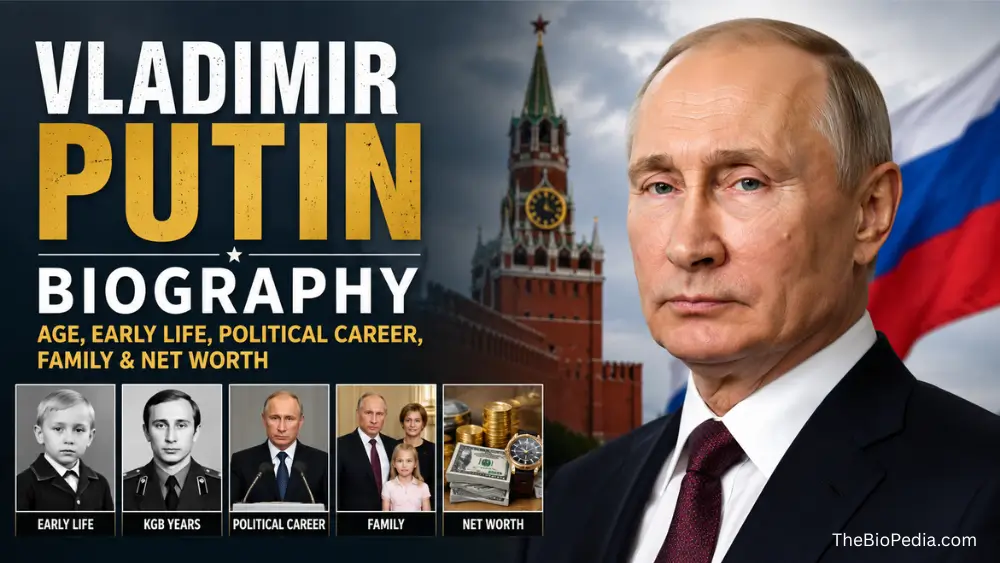
Few figures in modern world history have commanded as much attention, controversy, and geopolitical weight as Vladimir Putin. As the President of Russia and one of the longest-serving leaders of a major power in the 21st century, Putin has reshaped Russia’s domestic politics, redefined its relationships with the West, and left an indelible mark on global affairs.
This comprehensive Vladimir Putin biography covers every significant chapter of his life — from his working-class childhood in post-war Leningrad to his clandestine years as a KGB intelligence officer in East Germany, his calculated rise through Russian politics in the 1990s, and his transformation into one of the world’s most influential and polarizing leaders.
In this article, we explore his early life and education, his KGB career and Soviet intelligence work, his political career timeline from Prime Minister to President, his family and personal life, and the persistent questions surrounding his net worth and financial assets. We also examine the controversies that have defined — and continue to shadow — his presidency.
Whether you are researching Russian politics, studying contemporary world leaders, or simply seeking a reliable Vladimir Putin biography, this guide provides a thorough, factually grounded overview.
Contents
Quick Facts About Vladimir Putin
Before diving into the full biography, here is a quick-reference summary of the most important facts about Russia’s president:
| Category | Details |
| Full Name | Vladimir Vladimirovich Putin |
| Date of Birth | October 7, 1952 |
| Age | 73 years old (as of 2026) |
| Birthplace | Leningrad, Russian SFSR, Soviet Union (now Saint Petersburg, Russia) |
| Nationality | Russian |
| Profession | Politician, Former Intelligence Officer |
| Political Party | United Russia |
| Height | 5 ft 7 in (170 cm) |
| Education | Leningrad State University (Law, 1975); Ph.D. in Economics (1997) |
| Spouse | Lyudmila Putina (m. 1983; div. 2014) |
| Children | Two daughters — Maria and Katerina |
| Estimated Net Worth | $70 billion–$200 billion+ (media estimates; officially undisclosed) |
| Current Position | President of the Russian Federation (2000–2008; 2012–present) |
Vladimir Putin: Early Life & Childhood
Where Was Vladimir Putin Born?
Vladimir Vladimirovich Putin was born on October 7, 1952, in Leningrad — the city now known as Saint Petersburg — in the Russian Soviet Federative Socialist Republic of the USSR. His birth came just seven years after the end of World War II, and the city of Leningrad still carried the physical and psychological scars of the devastating 872-day Nazi siege that had claimed hundreds of thousands of lives.
Growing up in this environment profoundly influenced Putin’s worldview. The patriotism, resilience, and state-centric values instilled in Soviet citizens of that era — particularly those living in a city that had endured so much — became foundational to his identity. Leningrad was not merely a backdrop; it was a formative experience that shaped how Putin would later approach questions of national sovereignty, territorial integrity, and Russian identity on the world stage.
Vladimir Putin’s Parents & Family Background
Putin’s father, Vladimir Spiridonovich Putin, was a conscript in the Soviet Navy and later served in the NKVD — the predecessor to the KGB — during World War II. His father was wounded during the defence of Leningrad and carried the physical effects of that injury for years afterward.
His mother, Maria Ivanovna Putina (née Shelomova), was a factory worker and deeply devoted to her family. She survived the Siege of Leningrad through extraordinary hardship. Two older brothers — Viktor and Albert — both died young; one shortly after birth, and the other from diphtheria during the siege. Vladimir was, in effect, raised as an only child.
The family lived in a communal apartment in Leningrad — a modest, cramped arrangement typical of working-class Soviet life in that era. The conditions were humble: shared facilities with multiple families, limited resources, and a distinctly proletarian existence. It was an upbringing that Putin has spoken about in interviews, attributing much of his discipline and tenacity to the hardships of his youth.
Education & Early Interests
Putin attended School No. 193 in Leningrad for his early education before transferring to School No. 281, which emphasized chemistry and was attended by many children of the city’s scientific and intellectual community. By most accounts, he was an average but determined student.
Outside the classroom, Putin developed a serious passion for martial arts — initially sambo (a Soviet martial art) and later judo. He began training in judo at age 11 and would eventually earn a black belt, a source of considerable pride that he has maintained throughout his adult life. Judo, with its emphasis on discipline, leverage, and patience, is often cited as a metaphor for Putin’s political style.
In 1970, Putin enrolled at Leningrad State University to study law — a choice partially motivated, by his own admission, by his teenage ambition to join the Soviet intelligence services. He graduated in 1975 with a law degree. While at university, he reportedly made contact with representatives of the KGB, who encouraged his application to join the agency upon graduation.
For a deeper look at this period of his life, read our full article on Vladimir Putin Early Life & KGB Career: How He Entered Russian Politics.
Vladimir Putin’s KGB Career & Soviet Intelligence Years
Why Putin Joined the KGB
By his own account, Vladimir Putin’s desire to join the KGB began in childhood. In interviews, he has described being inspired by Soviet spy films and literature that portrayed intelligence officers as heroic defenders of the motherland. As a teenager, he reportedly visited the Leningrad office of the KGB and was informally advised to obtain a law degree before applying — advice he followed.
Upon graduating from Leningrad State University in 1975, Putin was recruited directly into the KGB (Komitet Gosudarstvennoy Bezopasnosti — the Committee for State Security), the Soviet Union’s principal security and intelligence agency. His entry into the KGB marked the beginning of nearly 16 years in Soviet intelligence work, an experience that fundamentally shaped his worldview, his methods, and his political instincts.
Training & Intelligence Work
After his recruitment, Putin underwent intelligence training at the KGB’s Red Banner Institute (also known as the Andropov Institute) near Moscow. His training covered surveillance, counterintelligence, recruitment of foreign agents, and the operational tradecraft of a professional intelligence officer.
His early KGB career was spent in Leningrad, where he worked in the counterintelligence division monitoring foreign nationals and identifying potential security threats. His work during this period was largely domestic in nature — tracking dissidents, monitoring foreign contacts, and gathering information for the state security apparatus.
Posting in East Germany
In 1985, Putin received a posting to Dresden in East Germany — a significant assignment for a KGB officer. He served there until 1990, working under the cover of the Soviet-East German Friendship House. His official role was to cultivate contacts and gather intelligence, though the precise nature of his operations during this period remains partially classified.
The Dresden posting exposed Putin to the realities of life outside the Soviet Union and gave him a front-row view of the political upheaval that would ultimately end the Cold War. When the Berlin Wall fell in November 1989 and East Germany began to collapse, Putin witnessed firsthand the speed with which an established political order could disintegrate. By some accounts, he and his KGB colleagues in Dresden burned documents to prevent them from falling into the hands of protesters who stormed the local KGB office — an experience that left a deep impression.
Putin has spoken about watching Soviet power recede during this period with what he described as a sense of abandonment — feeling that Moscow had offered no direction or support as the Eastern Bloc unravelled around him. This formative trauma arguably shaped his later obsession with Russian state power, sovereignty, and the danger of perceived weakness.
Fall of the Soviet Union & Career Shift
Putin returned to Leningrad in 1990 and resumed work with the KGB. However, the Soviet Union was in its death throes. Following the failed coup attempt against Mikhail Gorbachev in August 1991 and the formal dissolution of the USSR in December 1991, Putin resigned from the KGB — or, as he later described it, retired from active service — holding the rank of Lieutenant Colonel.
The collapse of the Soviet Union was a defining moment for Putin. He has famously described it as “the greatest geopolitical catastrophe of the 20th century” — a statement that reflects not nostalgia for communism, but a deep resentment over the loss of Russian influence, territory, and global standing. This perspective would become the philosophical bedrock of his presidency.
Vladimir Putin’s Entry Into Politics
Working Under Anatoly Sobchak
After leaving the KGB, Putin leveraged his Leningrad State University connections to enter local politics. He became an advisor to Anatoly Sobchak, the charismatic and reformist mayor of Saint Petersburg (Leningrad had been renamed in 1991). Sobchak was one of the leading democratic figures of the early post-Soviet era, and his office became a crucible of political talent.
Putin rose quickly within Sobchak’s administration. By 1994, he had become First Deputy Mayor of Saint Petersburg, overseeing the city’s external relations and foreign investment. He earned a reputation as an effective, if discreet, administrator — someone who could get things done without drawing unnecessary attention to himself. His KGB background, rather than being a liability in the new Russia, proved useful in managing the complex world of business, politics, and organized crime that characterized Saint Petersburg in the 1990s.
Rise in Moscow Politics
When Sobchak lost his re-election bid in 1996, Putin moved to Moscow. His competence and loyalty had attracted the attention of figures within the Kremlin’s presidential administration, and he was brought into the federal government. He served in a series of increasingly senior positions — including Head of the Federal Security Service (FSB), the KGB’s successor agency — demonstrating both political reliability and administrative capability.
His reputation as a capable, loyal, and discreet operator made him attractive to the circles surrounding the ailing President Boris Yeltsin, who was looking for a successor who could protect his legacy and manage Russia’s turbulent transition.
Relationship With Boris Yeltsin
Boris Yeltsin appointed Putin as Prime Minister of Russia in August 1999 — a move that surprised many political observers. At the time, Putin was relatively unknown to the Russian public. However, his decisive handling of the Second Chechen War — ordering a forceful military response to insurgent incursions into Dagestan — rapidly elevated his public profile and popularity.
On December 31, 1999 — New Year’s Eve — Yeltsin made a surprise announcement: he was resigning from the presidency and naming Putin as Acting President of Russia. It was a transition that many analysts regard as carefully choreographed, with mutual agreements of protection and non-prosecution reportedly part of the arrangement. Putin had gone from obscurity to the most powerful position in Russia in less than eighteen months.
For the full chronological account, read our article on Vladimir Putin Political Career Timeline: From Prime Minister to Russian President.
Vladimir Putin’s Rise to Power
Appointment as Prime Minister
Putin’s appointment as Prime Minister by Yeltsin in August 1999 came at a moment of significant national crisis. Russia was grappling with economic instability, the aftermath of the 1998 financial collapse, and escalating violence in the North Caucasus. Yeltsin was deeply unpopular, and the political class was deeply fragmented.
Putin’s response to the Chechen insurgency and a series of deadly apartment bombings — which Russian authorities attributed to Chechen terrorists, though questions about the bombings persist among some analysts — was swift and uncompromising. His public statements, including a now-infamous remark about hunting terrorists “wherever we find them,” resonated with a Russian public exhausted by instability and yearning for order. His approval ratings soared.
Becoming Acting President of Russia
When Yeltsin resigned on December 31, 1999, Putin assumed the role of Acting President. The symbolism was deliberate: Yeltsin chose New Year’s Eve, giving Putin maximum media coverage and a fresh-start narrative heading into the year 2000. Within weeks, Putin was conducting presidential duties — visiting troops in Chechnya, meeting foreign leaders, and projecting the image of decisive, confident leadership.
Winning the 2000 Presidential Election
Putin won the March 2000 presidential election in the first round with approximately 52.9% of the vote — a result that international observers noted occurred in conditions that were not fully free or fair, though sufficient to confer political legitimacy. His main opponents — including Communist Party candidate Gennady Zyuganov — were unable to match his combination of incumbency advantages, media dominance, and genuine public support.
Putin’s Leadership Style
From the outset of his presidency, Putin demonstrated a governing style built around several consistent principles: the centralization of political power, the reassertion of state control over key economic assets (particularly energy), the suppression of political opposition and independent media, and the cultivation of a strongman image rooted in physical vitality and decisiveness.
This approach — often described by analysts as “managed democracy” or “sovereign democracy” — allowed Putin to maintain electoral legitimacy while systematically eliminating the institutional checks that characterize liberal democracies. Independent television channels were brought under state or state-aligned ownership. Regional governors, previously elected, were made presidential appointees. Political parties outside the Kremlin’s control were marginalized.
Vladimir Putin: Presidential Election Timeline
| Year | Result | Significance |
| 2000 | Won Presidential Election (52.9% of vote) | First presidential term begins |
| 2004 | Re-elected President (71.3% of vote) | Second presidential term |
| 2008 | Prime Minister under President Medvedev | Constitutional term limit reached |
| 2012 | Returned as President (63.6% of vote) | Third presidential term begins |
| 2018 | Re-elected President (76.7% of vote) | Fourth presidential term |
| 2024 | Re-elected President (87.3% of vote) | Fifth presidential term; extended to 2030 |
Vladimir Putin as President of Russia
Economic Policies & Growth
Putin’s first two presidential terms (2000–2008) coincided with a period of remarkable — if uneven — economic growth in Russia. Rising global oil and gas prices, combined with macroeconomic stabilization measures, delivered sustained GDP growth that dramatically improved living standards for millions of Russians. Poverty rates fell, real wages rose, and Russia paid off its Soviet-era debts ahead of schedule.
Critics, however, argued that this prosperity was largely the product of commodity prices rather than structural reform. The Russian economy remained heavily dependent on hydrocarbon exports, and the state’s growing role in strategic industries — including the nationalization of major oil companies — raised concerns about the long-term sustainability of growth and the rule of law for business.
Military & Foreign Policy
Putin’s foreign policy has been defined by the reassertion of Russian power and influence, resistance to NATO expansion, and an interventionist approach to what Russia considers its sphere of legitimate interest. Key military interventions have included the Second Chechen War (1999–2009), the Russo-Georgian War of 2008, Russia’s annexation of Crimea in 2014, and the full-scale invasion of Ukraine launched in February 2022.
The Russian military was substantially modernized and restructured during Putin’s presidency, with significant investment in new weapons systems, nuclear capabilities, and power-projection capacity. Russia’s military has been used as both an instrument of direct force and a tool of coercive diplomacy in shaping regional and global outcomes.
Relations With the United States & Europe
Putin’s relationship with Western governments has moved through several distinct phases — from initial cooperation following September 11, 2001, through growing friction over NATO expansion and democracy promotion, to outright hostility following the Ukraine conflict. Russia’s relationship with the European Union has been similarly transformed, with sanctions and counter-sanctions reshaping trade, energy, and diplomatic ties.
The expulsion of Russian diplomats, asset freezes, and sweeping economic sanctions imposed following the 2022 invasion of Ukraine represented the most severe deterioration in Russia-West relations since the Cold War. Putin has consistently characterized Western policies as aggressive encirclement and as a threat to Russian national security.
Russia-Ukraine Conflict Overview
The Russia-Ukraine conflict, which escalated dramatically in February 2022 with Russia’s full-scale invasion, represents the defining geopolitical crisis of Putin’s later presidency. Russia’s stated objectives — the “denazification” and “demilitarization” of Ukraine — were widely rejected by the international community. Ukraine, with substantial Western military and financial support, has mounted a sustained resistance.
The conflict has resulted in tens of thousands of casualties, the displacement of millions of Ukrainians, and profound consequences for European security architecture, global energy markets, and the international rules-based order. Putin faces an International Criminal Court arrest warrant — issued in 2023 — related to the alleged unlawful deportation of Ukrainian children, a warrant he dismisses as politically motivated.
Constitutional Changes & Extended Presidency
In 2020, Putin oversaw a set of constitutional amendments that reset the presidential term counter — effectively allowing him to serve until 2036 if he wins future elections. The amendments were approved in a nationwide vote conducted under conditions critics described as neither free nor transparent. The changes also incorporated socially conservative elements, including a definition of marriage as being between a man and a woman.
Following his re-election in March 2024 — with an officially reported 87.3% of the vote — Putin began his fifth presidential term. Western governments and independent election monitors questioned the legitimacy of the election given the near-total absence of meaningful political competition.
Vladimir Putin: Family, Wife & Personal Life
Marriage to Lyudmila Putina
Vladimir Putin married Lyudmila Shkrebneva — a former Aeroflot flight attendant — in July 1983. The couple met in Leningrad while Putin was still serving in the KGB, and by most accounts the early years of their marriage were spent navigating the demands of his intelligence career, including the posting to East Germany from 1985 to 1990.
The marriage lasted officially until 2014, when the couple announced their divorce in a brief, coordinated television appearance — stating with notable composure that their marriage was “over” due to the demands of Putin’s public life. The divorce was widely noted for its choreographed quality. Lyudmila has since largely withdrawn from public life, and virtually nothing is publicly confirmed about her current circumstances.
Vladimir Putin’s Children
Putin and Lyudmila had two daughters. Maria Vladimirovna Putin (born 1985, also reported under the name Vorontsova) is reportedly a medical researcher and has been linked to healthcare-related business interests. Katerina Vladimirovna Tikhonova (born 1986) is reportedly involved in technology and business ventures. Both daughters have been sanctioned by Western governments as part of the broader sanctions regime targeting the Putin family and associates.
Putin has been notably protective of his daughters’ privacy throughout his presidency, rarely acknowledging them in public, though their identities have been reported by investigative journalists. Reports of additional children — including alleged relationships with prominent Russian women — have circulated in the media, but none have been officially confirmed.
Hobbies & Lifestyle
Putin’s public image is carefully cultivated around themes of physical strength, discipline, and outdoor vitality. He is a black belt in judo and has practiced the sport throughout his adult life. He has been photographed participating in judo sessions, ice hockey games, skiing, swimming, and horseback riding — often in settings designed to project physical vigour.
He is also known to be an avid ice hockey player, participating in exhibition matches with current and former NHL players as well as Russian hockey stars — games that critics note are staged to ensure he performs impressively. His physical presentation — bare-chested photos on horseback, fishing in Siberia, diving to “discover” ancient artefacts — has become a globally recognized element of his political persona.
Religion & Personal Beliefs
Putin identifies as a Russian Orthodox Christian and has cultivated a close relationship with the Russian Orthodox Church throughout his presidency. He has described his Christian faith as deeply personal and has credited his late mother with instilling religious belief in him despite the atheism officially promoted under Soviet communism.
The Russian Orthodox Church has, in turn, provided significant ideological support for Putin’s presidency — including, controversially, Patriarch Kirill’s framing of the war in Ukraine in theological terms. Critics argue that the relationship between the Kremlin and the Church has become mutually reinforcing in ways that blur the constitutional separation of church and state.
For an in-depth look at Putin’s family dynamics and personal life, read our full article on Vladimir Putin Family, Wife & Personal Life: Inside the Russian Leader’s Private World.
Vladimir Putin: Net Worth & Assets
Official Salary
Vladimir Putin’s official declared salary as President of Russia is relatively modest by global standards. According to Russian government disclosures, his annual presidential salary is approximately 10.7 million rubles — equivalent to roughly $120,000–$150,000 USD at prevailing exchange rates, depending on the year. He has also declared ownership of a small apartment, a modest amount of savings, and several vehicles in official asset declarations.
Estimated Net Worth Reports
The gap between Putin’s declared assets and his estimated actual wealth is, by virtually every journalistic and intelligence assessment, enormous. Various credible estimates have placed his true net worth at anywhere from $70 billion to over $200 billion, which would make him among the wealthiest individuals on the planet — if such figures are accurate.
These estimates are based on investigative reporting, leaked financial documents — including the Panama Papers — and intelligence assessments from Western governments. The Pandora Papers (2021) provided additional evidence of offshore financial arrangements linked to Putin’s inner circle. The underlying theory is that Putin exercises effective control over assets nominally owned by oligarchs and businessmen who serve at his pleasure — a system sometimes described as “implicit ownership” or a “kleptocratic” model of governance.
Luxury Homes, Cars & Private Jets
Among the assets linked to Putin through investigative journalism is a sprawling Black Sea palace near Gelendzhik — a property reportedly valued at over $1 billion and described in a widely viewed 2021 documentary by opposition leader Alexei Navalny. The Kremlin denied Putin’s ownership of the property. Additional residences — including estates in the Moscow region and other luxury retreats — have been documented by various investigative outlets.
Putin is also associated with a significant fleet of aircraft, including multiple presidential aircraft and a reportedly luxurious personal jet. A superyacht — named Graceful — was widely reported to be linked to Putin and was moved out of European waters ahead of Western sanctions in February 2022.
Financial Controversies & Sanctions
Following Russia’s 2022 invasion of Ukraine, Western governments imposed sweeping sanctions targeting Putin personally as well as his associates, family members, and the Russian state. Putin was personally sanctioned by the United States, European Union, United Kingdom, and numerous other countries — measures that formally freeze any assets held in those jurisdictions and impose travel bans.
The practical effect of personal sanctions on Putin is limited by the structure of his alleged wealth, which is reportedly distributed through intermediaries and located largely outside the reach of Western jurisdictions. Nevertheless, sanctions have targeted the oligarchs believed to manage assets on Putin’s behalf, and asset seizures have affected billions of dollars of Russian-linked wealth in European and US jurisdictions.
Note: The information in this section clearly separates verified, officially declared information from media estimates and unverified allegations. Readers should distinguish between Putin’s official declared assets (verified) and estimates of his alleged true wealth (unverified, based on investigative reporting and assessments).
For a detailed breakdown of Putin’s wealth estimates, assets, and financial controversies, read our full article on Vladimir Putin Net Worth & Assets: Salary, Wealth, Luxury Homes & Influence.
Major Controversies & Criticism
Media Freedom & Opposition Issues
One of the most persistent criticisms of Putin’s presidency concerns the treatment of independent media and political opposition. Since 2000, Russia has experienced a systematic consolidation of media ownership under state control or state-aligned interests. Independent television networks, newspapers, and online publications have been closed, taken over, or driven out of business.
Opposition figures have faced a pattern of legal persecution, exile, and — in a significant number of documented cases — violence. The most high-profile case is that of Alexei Navalny, Putin’s most prominent domestic critic, who survived a poisoning with the Novichok nerve agent in 2020 (an attack that Western governments attributed to Russian state actors), was imprisoned in 2021, and died in custody in a Russian Arctic penal colony in February 2024 under circumstances that prompted widespread international condemnation.
International Sanctions
Russia has faced waves of international sanctions across Putin’s presidency — notably following the annexation of Crimea in 2014 and in an unprecedented scale following the full-scale invasion of Ukraine in 2022. The 2022 sanctions package included the freezing of approximately $300 billion in Russian central bank reserves held in Western jurisdictions — a measure with no historical precedent in the modern financial system.
The sanctions regime has significantly damaged the Russian economy, contributed to currency depreciation, and isolated Russia from large segments of the global financial system. Russia has partially adapted through increased trade with China, India, and other non-sanctioning countries, but the long-term economic costs remain substantial.
Human Rights Criticism
Putin’s presidency has been consistently criticized by international human rights organizations including Amnesty International, Human Rights Watch, and Freedom House. Documented concerns include the restriction of civil liberties, the suppression of LGBTQ+ rights (including legislation criminalizing “gay propaganda”), the persecution of religious minorities, the treatment of political prisoners, and — most extensively — the conduct of military operations in Chechnya, Georgia, Syria, and Ukraine.
Geopolitical Disputes
Beyond Ukraine, Putin’s presidency has been marked by significant geopolitical disputes: Russia’s military intervention in Syria in support of Bashar al-Assad’s government, alleged interference in the 2016 United States presidential election, the use of nerve agents against individuals on British soil (the Salisbury poisoning of 2018), and sustained cyberattacks attributed to Russian state actors against Western governments and critical infrastructure.
The cumulative effect of these controversies has been the near-complete isolation of Putin’s Russia from the community of Western liberal democracies — a condition that Putin frames not as isolation but as a deliberate assertion of Russian sovereign independence.
Awards, Honors & Global Influence
Within Russia, Putin holds the country’s highest state honours. He was awarded the Order for Services to the Fatherland and other state decorations. Among his judo achievements, he holds an 8th Dan black belt — a rank conferred by international judo bodies, though the conferral was later reviewed amid controversy following Russia’s invasion of Ukraine.
On the global stage, Putin was named Time magazine’s Person of the Year in 2007 — a recognition of his influence, not an endorsement of his governance. He has consistently ranked among the most powerful people in the world in various international indices, reflecting the reality that, whatever one’s assessment of his character or methods, his decisions affect hundreds of millions of people.
As of 2026, Putin is the longest-serving Russian leader since Joseph Stalin — a comparison that carries deep historical weight and that both his supporters and critics invoke, though for very different reasons. His influence on the trajectory of Russian domestic politics, the European security order, and global great-power competition is arguably unmatched among world leaders of his generation.
Interesting Facts About Vladimir Putin
Here are some lesser-known but revealing facts about Russia’s president:
- Black Belt in Judo: Putin began training in judo at age 11 and holds an 8th Dan black belt — one of the highest ranks in the sport. He has co-authored a book on judo technique.
- Former KGB Spy: Before entering politics, Putin spent approximately 16 years in the KGB, rising to the rank of Lieutenant Colonel. His intelligence background deeply informs his political methods and worldview.
- Fluent in German: As a result of his posting in East Germany, Putin is fluent in German — a language skill he has demonstrated in diplomatic settings. He also speaks conversational English.
- Born into Extreme Poverty: Putin’s family lived in a communal apartment and faced severe economic hardship. He has described catching rats as a child to understand and deal with threatening situations — a formative metaphor he has referenced in public speeches.
- Survived Political Obscurity: As recently as 1996, Putin was a relatively junior official following Mayor Sobchak’s electoral defeat. His rise from that low point to the Russian presidency within three years is among the most remarkable political ascents in modern history.
- Holds a Doctorate: Putin holds a Candidate of Sciences degree (roughly equivalent to a Ph.D.) in economics from the Saint Petersburg State Mining Institute, awarded in 1997. The authenticity and originality of the thesis have been questioned by some researchers.
- New Year’s Eve Presidency: Putin became Acting President of Russia on December 31, 1999 — one of the most symbolically loaded dates in modern Russian political history.
- Avid Ice Hockey Player: Putin plays ice hockey regularly and participates in high-profile exhibition matches. He has reportedly scored impressive numbers of goals in these games — leading to considerable public scepticism about their competitive integrity.
FAQs
How old is Vladimir Putin?
Vladimir Putin was born on October 7, 1952, making him 73 years old as of 2026. He is one of the older heads of state among major world powers currently in office.
What is Vladimir Putin’s net worth?
Vladimir Putin’s official declared net worth — based on Russian government disclosures — is very modest for a head of state. However, investigative journalists, Western intelligence assessments, and leaked financial documents (including the Panama Papers) suggest his true wealth may range from $70 billion to over $200 billion, held through intermediaries and offshore structures. These figures are estimates and remain unverified; Putin himself denies such wealth.
Was Vladimir Putin in the KGB?
Yes. Vladimir Putin served in the KGB — the Soviet Union’s Committee for State Security — for approximately 16 years, from 1975 to 1991. He worked in counterintelligence in Leningrad, underwent intelligence training near Moscow, and was posted to Dresden, East Germany from 1985 to 1990. He retired from the KGB holding the rank of Lieutenant Colonel following the collapse of the Soviet Union.
Does Vladimir Putin have children?
Vladimir Putin has two officially acknowledged daughters: Maria (also reported as Mariya Vorontsova), born in 1985, reportedly involved in medical research; and Katerina (also reported as Katerina Tikhonova), born in 1986, reportedly involved in technology ventures. Both have been subject to Western sanctions. Reports of additional children have circulated in investigative media reports but have not been officially confirmed.
When did Vladimir Putin become president?
Vladimir Putin first became president of Russia on May 7, 2000, following his victory in the March 2000 presidential election. He had previously served as Acting President from December 31, 1999, following Boris Yeltsin’s resignation. He served two terms (2000–2008), served as Prime Minister under President Medvedev (2008–2012), and returned to the presidency in 2012. He was re-elected in 2018 and again in 2024, with constitutional amendments potentially allowing him to remain in power until 2036.
Where was Vladimir Putin born?
Vladimir Putin was born in Leningrad, Russian SFSR, Soviet Union — the city now known as Saint Petersburg, Russia. He was born on October 7, 1952, in a city still bearing the profound physical and psychological marks of the World War II siege.
What is Vladimir Putin known for?
Vladimir Putin is known for: his transformation of Russia from a fragile post-Soviet democracy into a centralized authoritarian state under his control; his aggressive foreign policy, including the annexation of Crimea and the invasion of Ukraine; his KGB background and intelligence-shaped political style; his cultivation of a strongman public image; the enormous — if opaque — wealth attributed to him by investigative journalists; his suppression of political opposition and independent media; and his positioning of Russia as a counterweight to Western liberal democratic influence. He is one of the most consequential — and controversial — political figures of the 21st century.
Conclusion
The Vladimir Putin biography is one of the most consequential political stories of the modern era. From a working-class childhood in post-war Leningrad to nearly two and a half decades as the dominant force in Russian politics, Putin’s trajectory defies simple characterization. He is simultaneously a product of the Soviet system and its most successful political survivor — a man who watched that system collapse around him and spent the following decades rebuilding, on his own terms, a version of Russian power that commands global attention.
His early life — shaped by poverty, discipline, and the KGB — produced a leader whose methods are often opaque but whose strategic patience and political instincts have proven formidable. His political career, from the offices of Saint Petersburg’s mayor to the Kremlin, represents one of the most rapid and calculated rises to power in modern political history.
His presidency has delivered genuine improvements in living standards for many Russians alongside systematic dismantling of democratic institutions, aggressive military adventurism, and an international isolation that has accelerated dramatically since 2022. His family life remains shrouded in deliberate secrecy, his true wealth remains one of the world’s great unanswered financial questions, and his long-term legacy — in Russia, in Europe, and in the global order — will be debated for generations.
Continue Reading About Vladimir Putin:
For a deeper understanding of any aspect of Putin’s biography, explore the articles in this series:
- Vladimir Putin Early Life & KGB Career — his intelligence years in detail
- Vladimir Putin Political Career Timeline — the full chronology of his political rise
- Vladimir Putin Family, Wife & Personal Life — his family, relationships, and private world
- Vladimir Putin Net Worth & Assets — the full story of his alleged wealth