
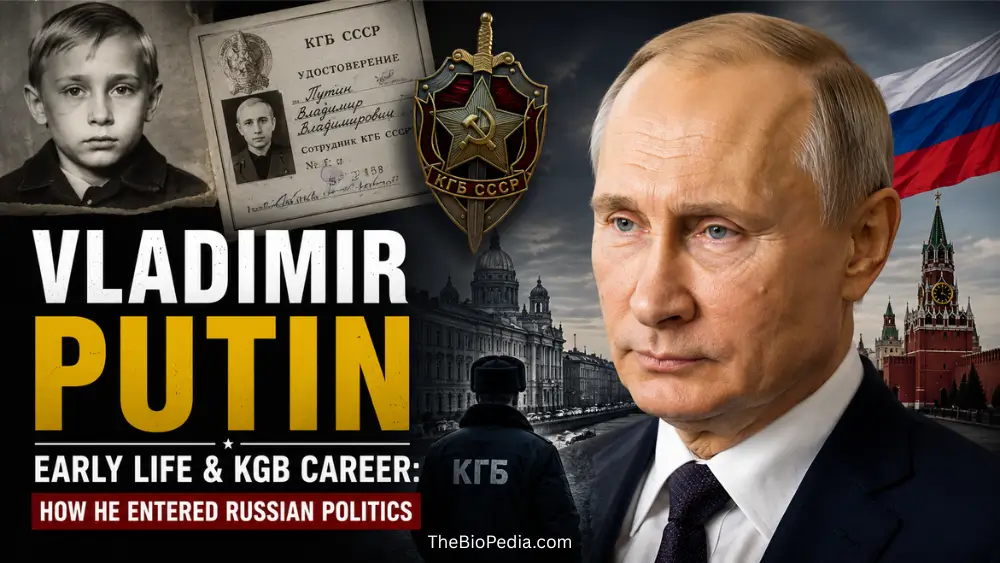
Long before Vladimir Putin became the President of Russia — before the televised press conferences, the Kremlin corridors, and the geopolitical confrontations that would define an era — he was a quiet, disciplined boy growing up in a cramped communal apartment in post-war Leningrad. He was the son of a wounded war veteran and a factory worker who had survived one of history’s most brutal sieges. His world was modest, Soviet, and deeply shaped by sacrifice.
Understanding Vladimir Putin’s early life is not merely a biographical exercise. It is essential context for understanding the man who would go on to reshape Russia’s relationship with the world. The values he absorbed in childhood — patriotism, toughness, distrust of weakness, and a profound attachment to Russian state power — were not adopted later as political positions. They were formed early, in the streets of Leningrad and the training halls of the KGB, and they have remained consistent throughout his decades in power.
This article traces the full arc of Vladimir Putin’s early years: his Soviet upbringing, his education and growing passion for martial arts, his calculated decision to join the KGB, his intelligence training and domestic security work, his posting to East Germany during the Cold War’s final act, and his eventual transition from intelligence officer to political operative. It is the story of how a man shaped by the Soviet system became the figure who would, in many ways, attempt to resurrect its spirit — on his own terms.
For a complete overview of Putin’s life from birth to the present, read our article Vladimir Putin Biography: Age, Early Life, Political Career, Family & Net Worth.
Contents
Quick Facts About Young Vladimir Putin
Before exploring the full narrative, here is a concise reference table covering the key facts about Putin’s early life and KGB career:
| Category | Details |
| Full Name | Vladimir Vladimirovich Putin |
| Birth Date | October 7, 1952 |
| Birthplace | Leningrad, Russian SFSR, Soviet Union (now Saint Petersburg, Russia) |
| Education | Leningrad State University — Law Degree (1975); Ph.D. in Economics (1997) |
| KGB Service Years | 1975–1991 (approx. 16 years); retired as Lieutenant Colonel |
| Languages Spoken | Russian (native), German (fluent), English (conversational) |
| First Political Role | Advisor to Mayor Anatoly Sobchak of Saint Petersburg (1990–1991) |
Vladimir Putin’s Childhood in Leningrad
Where Was Vladimir Putin Born?
Vladimir Vladimirovich Putin was born on October 7, 1952, in Leningrad — the city that is today known as Saint Petersburg. At the time of his birth, Leningrad was one of the great industrial and cultural centres of the Soviet Union, but it was also a city still recovering from the catastrophic destruction of World War II.
The Siege of Leningrad — a 872-day German blockade that lasted from September 1941 to January 1944 — had devastated the city and killed an estimated 800,000 to one million civilians through starvation, bombardment, and disease. The physical and psychological scars of that siege were still deeply visible and emotionally present in Leningrad’s collective memory when Putin was growing up in the 1950s and 1960s. Memorials were everywhere. The adults around him had survived the unimaginable. Patriotism was not an abstraction; it was woven into the fabric of daily life.
This environment — a city defined by suffering, survival, and fierce pride — left a lasting imprint on Putin’s character. The Soviet state’s narrative of heroic endurance, of motherland above all, resonated deeply in a place like Leningrad, and the young Putin absorbed it fully. His later rhetoric about Russian strength, sovereignty, and the danger of foreign encirclement draws on a worldview shaped partly by this geography of memory.
Family Background & Parents
Putin’s father, Vladimir Spiridonovich Putin, served in the Soviet Navy before the war and later in the NKVD — the predecessor to the KGB — during World War II. He fought in the defence of Leningrad and was seriously wounded, sustaining injuries that left a permanent mark. After the war, he worked as a factory foreman — a working-class job that placed the family firmly among Leningrad’s proletariat.
His mother, Maria Ivanovna Putina (née Shelomova), was a resilient and deeply devoted woman who worked in a series of factory and manual labour jobs to help support the family. She endured the Siege of Leningrad and survived extraordinary hardship, including severe malnutrition. Her husband fell gravely ill during the siege, and the family’s survival was, by any measure, a testament to tenacity.
Two older sons — Viktor and Albert — had both died young before Vladimir was born: one shortly after birth, and Albert from diphtheria contracted during the siege. Vladimir was, in effect, the family’s only surviving child — a status that made him precious to his parents and that, by his own account, meant he was raised with both deep affection and high expectations.
The family lived in a kommunalka — a communal apartment shared with other families, with shared kitchen and bathroom facilities. It was a living arrangement typical of working-class Soviet urban life and a world away from comfort or privilege. Putin has spoken about this upbringing with apparent pride rather than resentment, framing it as the foundation of his discipline and resilience.
School Life & Early Interests
Putin’s Education
Putin began his schooling at a local Leningrad school and was, by most accounts, an average but determined student — not a prodigy, but someone with enough tenacity to achieve what he set his mind to. He later transferred to School No. 281, a school with a chemistry specialization that attracted children from more educated and professional families in Leningrad.
Despite the school’s academic orientation, what distinguished Putin at this age was not chemistry or mathematics but law and political awareness. From a young age, he displayed an interest in questions of power, governance, and the mechanisms of the state — an interest that would eventually lead him, deliberately and with considerable premeditation, toward both a law degree and the Soviet intelligence apparatus.
He enrolled at Leningrad State University’s law faculty in 1970, graduating in 1975 with a degree in law. At university, Putin was a focused if not brilliant student. He later completed a Candidate of Sciences thesis — roughly equivalent to a doctorate — at the Saint Petersburg State Mining Institute in 1997, on the subject of strategic planning in Russia’s natural resource sector, though the originality of that work has been questioned by some academic researchers.
Martial Arts & Discipline
If one element of Putin’s early years stands out above all others as a character-shaping force, it is his dedication to martial arts. He began training in sambo — a Soviet martial art combining elements of wrestling and judo — at around age 11, and shortly afterward took up judo, which would become a lifelong pursuit.
Judo was more than a sport for Putin. It was a discipline — a system of thought as much as physical technique. Judo’s philosophical underpinnings emphasize using an opponent’s force against them, patience, strategic positioning, and the importance of mental composure under pressure. These are qualities that political analysts have consistently identified in Putin’s leadership style: the willingness to wait, the capacity to absorb pressure and redirect it, and the deeply held belief that discipline and preparation beat raw aggression.
He trained seriously and competitively, eventually earning a black belt and competing at a regional level. By his own account, judo taught him the value of hard work and instilled a confidence — born not from privilege but from mastered skill — that helped him navigate the difficult social terrain of Soviet Leningrad, where toughness was respected and weakness exploited.
Putin holds an 8th Dan black belt in judo and has co-authored a book on judo technique. He has continued to practice the sport throughout his adult life, regularly attending training sessions and participating in demonstration events — activities that also serve his carefully managed public image as a physically formidable leader.
Why Vladimir Putin Joined the KGB
Interest in Intelligence Work
Putin has been unusually candid — for a man who guards most aspects of his inner life carefully — about his childhood ambition to join the KGB. In interviews and his authorized biography, he has described being captivated from a young age by Soviet films and literature that portrayed intelligence officers as selfless patriots protecting the motherland from foreign enemies.
The Cold War atmosphere of 1950s and 1960s Leningrad was saturated with this imagery. Soviet culture celebrated the intelligence officer as a heroic archetype — the quiet professional who operated in shadows to defend everything ordinary citizens held dear. For a patriotic boy raised on stories of sacrifice and survival in a city that had resisted Nazi siege, this narrative carried enormous emotional weight.
In a remarkable illustration of his youthful determination, Putin reportedly visited the Leningrad offices of the KGB as a teenager — on his own initiative — to ask how one might go about joining the intelligence service. He was informally told that the best route was a university education, preferably in law. This was not a casual aspiration; it was a goal that shaped his educational choices and his entire early adult trajectory. He enrolled in law at Leningrad State University specifically with the KGB in mind.
Joining the KGB After University
Upon graduating from Leningrad State University with his law degree in 1975, Putin was recruited directly into the KGB — the Committee for State Security — the Soviet Union’s principal intelligence, security, and secret police organization. His recruitment was not a surprise; he had effectively been working toward this moment for years, and his university contacts with KGB representatives had laid the groundwork.
Joining the KGB in 1975 was a significant achievement. The agency was at the height of its power and prestige in the Soviet system — a massive, feared institution with tentacles reaching into every aspect of Soviet life, from domestic surveillance and political repression to foreign intelligence gathering and covert operations abroad. For a disciplined, patriotic young man from a working-class background, it represented not merely a job but a vocation — a calling aligned with everything he had been taught to value.
His entry into the KGB also represented a significant social elevation. Despite the Soviet Union’s officially classless ideology, KGB officers occupied a privileged stratum — access to special shops, better housing, foreign postings, and a level of institutional respect that came from being the guardians of state security. For Putin, it was the beginning of a transformation from the cramped kommunalka of his childhood into the corridors of real power.
Vladimir Putin’s KGB Training & Intelligence Career
Intelligence Training
After his recruitment into the KGB in 1975, Putin underwent rigorous professional training at the KGB’s prestigious Red Banner Institute — also known as the Andropov Institute — located outside Moscow. This was the KGB’s principal training academy for officers destined for intelligence and foreign operations work, as distinct from the domestic security divisions.
Training at the Red Banner Institute was comprehensive and demanding. It covered the full spectrum of intelligence tradecraft: surveillance and counter-surveillance techniques, the cultivation and recruitment of foreign agents (known as “assets”), the operational methods of running agent networks, cryptography, cover story construction and maintenance, psychological profiling, and the analysis and production of intelligence reports. Officers also received intensive language training — Putin’s German language skills were developed and refined during this period.
The training was not merely technical. It was also ideological — designed to produce officers who understood their work not just as a profession but as a patriotic duty in service of the Soviet state’s survival against the hostile forces of Western imperialism. For a man of Putin’s background and beliefs, this ideological framing resonated naturally.
Early KGB Assignments
Following his training, Putin was assigned to the KGB’s Second Chief Directorate — the counterintelligence division — in Leningrad. His early work focused on monitoring foreign nationals living in or visiting the city, identifying potential security threats, and watching for attempts by Western intelligence services to recruit Soviet citizens.
Counterintelligence work of this kind was methodical, patient, and largely invisible — qualities that suited Putin well. It required the ability to build trust with targets over time, to gather information without revealing one’s hand, and to work within institutional structures while exercising considerable individual judgment. These skills — cultivated over years of intelligence work — would later manifest in his political methods: the long game, the strategic patience, the capacity to appear reasonable while pursuing specific objectives with unwavering focus.
Role in Soviet Security Operations
The precise details of Putin’s domestic KGB work during the late 1970s and early 1980s remain partially classified and have not been fully disclosed. What is known is that he worked within the Leningrad KGB apparatus during a period when the Soviet security services were engaged in monitoring dissidents, religious groups, Jewish emigration activists, and foreign contacts — the full range of internal security concerns that preoccupied the late Soviet state.
Putin has been consistently circumspect about the specifics of his KGB work, acknowledging its general nature without elaborating on individual operations or targets. This reticence is itself consistent with intelligence culture — officers are trained to protect operational details and maintain discretion about their past work. It also, of course, protects him from accountability for whatever that work involved.
What is clear is that Putin performed competently enough in his domestic assignments to be selected for what was, within the KGB, a genuinely prestigious foreign posting — East Germany — in 1985.
Vladimir Putin KGB Career Timeline
| Year / Period | Key Event |
| 1975 | Recruited into KGB after graduating from Leningrad State University |
| 1975–1984 | Counterintelligence work in Leningrad; KGB training at Red Banner Institute near Moscow |
| 1985–1990 | Posting to Dresden, East Germany — intelligence operations under Cold War conditions |
| 1989 | Witnessed the fall of the Berlin Wall and the collapse of East German communist rule |
| 1990 | Returned to Leningrad; continued KGB service during Soviet Union’s final phase |
| 1991 | Resigned from the KGB following the failed coup against Gorbachev; retired as Lieutenant Colonel |
Putin’s Time in East Germany
Assignment in Dresden
In 1985, Putin received a posting to Dresden in the German Democratic Republic — East Germany. He would remain there until 1990, a period of five years that would prove to be among the most formative of his life. His official cover was as a representative of the Soviet-East German Friendship House, but his actual function was that of a KGB intelligence officer, tasked with cultivating contacts, monitoring the local environment, and gathering intelligence relevant to Soviet interests.
Dresden was not East Berlin — it was a secondary posting, away from the most sensitive intelligence operations centred in the East German capital. Some analysts have interpreted this as suggesting Putin was a competent but not exceptional officer; others have argued that Dresden’s proximity to West Germany and its significant industrial and military infrastructure made it a posting of genuine intelligence value.
Life in East Germany gave Putin his first sustained exposure to a society outside the Soviet Union — albeit still a communist one. He lived in a KGB compound with his wife Lyudmila and their daughters, attended language classes, and operated within the relatively insular world of Soviet intelligence personnel abroad. His German, already trained at the Red Banner Institute, became genuinely fluent during this period. He also gained operational experience of a more complex kind than his Leningrad work had provided, building contacts across the range of East German institutions.
Fall of the Berlin Wall & Soviet Collapse
The period from 1989 to 1990 was one of the most dramatically transformative in modern European history — and Putin witnessed it at close quarters. The peaceful revolutions that swept Eastern Europe in 1989, the fall of the Berlin Wall on November 9, 1989, and the subsequent rapid dissolution of communist East Germany represented the most vivid possible demonstration of how quickly established political orders could collapse.
When protesters in Dresden stormed the local Stasi (East German secret police) offices and then turned their attention toward the KGB compound, Putin reportedly confronted the crowd personally, warning them that Soviet soldiers were present and prepared to defend the building. He also, by his own account, burned KGB documents to prevent them from falling into unauthorized hands — a frantic act of institutional protection in the face of political implosion.
Most critically, Putin found himself waiting for instructions from Moscow that never came. The Soviet centre, consumed by its own political crisis, offered no direction to its officers in the field. In Putin’s own words, he “understood that the Soviet Union was sick” and that he and his colleagues had been abandoned in the face of the crisis. This experience — of watching a superpower collapse, of feeling the state’s protective structures dissolve around him, and of receiving silence where guidance should have been — left a psychological imprint that has never fully faded.
Putin has explicitly cited the Soviet Union’s collapse as the greatest geopolitical catastrophe of the 20th century. The chaos and humiliation he witnessed in Dresden — Soviet power evaporating, East Germany’s communist order crumbling in days, Moscow mute — gave that conviction its emotional foundation. It explains much about his subsequent obsession with Russian state strength, his zero-tolerance for what he perceives as Western encirclement, and his determination that Russia will never again find itself in such a position of weakness.
The Collapse of the Soviet Union & Career Transition
Leaving the KGB
Putin returned to Leningrad in 1990, resuming his KGB work in the city as the Soviet Union entered its terminal phase. The attempted coup against Mikhail Gorbachev in August 1991 — by hardliners seeking to reverse his reforms — failed within days, and its collapse accelerated the Soviet Union’s disintegration. By December 1991, the USSR formally ceased to exist.
Putin resigned from the KGB in August 1991, following the failed coup — or, as he has described it at different times, retired from active service. He held the rank of Lieutenant Colonel at the time of his departure. The KGB itself was subsequently dissolved and restructured into successor agencies, the most significant of which — the FSB (Federal Security Service) — Putin would later lead.
His departure from the KGB marked the end of a 16-year career that had defined his professional identity. But the KGB had not merely been a job; it had been an institution that had shaped how Putin saw the world — the value of intelligence, the importance of loyalty, the necessity of discipline, the ever-present reality of foreign threats, and the central role of the state as guarantor of order and security. These were not views he left behind with his service record. They travelled with him into politics.
Return to Saint Petersburg
After leaving the KGB, Putin returned to Leningrad State University, working as an assistant to the rector while also reconnecting with his former law professor and mentor, Anatoly Sobchak. Sobchak had become one of the most prominent democratic reformers in the Soviet Union and was running for election as Chairman of the Leningrad City Council (and later as Mayor of the newly renamed Saint Petersburg).
Putin’s KGB background, legal training, and reputation for competence and discretion made him a natural fit for Sobchak’s team. He began working as an advisor to Sobchak’s administration in 1990, handling external relations and representing the city’s government in dealings with foreign businesses and investors. It was the beginning of a political career that would, within a decade, place him at the apex of Russian power.
To follow the full chronology of Putin’s political rise from Saint Petersburg to the Kremlin, read our detailed article on Vladimir Putin Political Career Timeline: From Prime Minister to Russian President.
How Vladimir Putin Entered Russian Politics
Working Under Anatoly Sobchak
Anatoly Sobchak was one of the defining political figures of Russia’s democratic transition period in the early 1990s — a charismatic law professor turned politician who embodied the reformist idealism of the Gorbachev era. His team was a gathering point for talented, pragmatic individuals who could navigate the intersection of new democratic politics and the complex legacy of Soviet institutions.
Putin flourished in this environment. He was appointed Deputy Mayor of Saint Petersburg by 1994, overseeing the city’s Committee for External Relations — a role that gave him responsibility for attracting foreign investment, managing international partnerships, and handling the kind of complex, discreet negotiations that required both legal acumen and the instincts of a trained intelligence officer. He earned a reputation as someone who could get things done, who was unfailingly loyal to those he served, and who maintained the kind of operational discretion that the turbulent, often dangerous world of 1990s Russian business and politics demanded.
Saint Petersburg in the 1990s was a city of considerable political and criminal complexity — a place where newly liberalized businesses, organized crime, foreign capital, and Soviet-era institutions intersected in often unpredictable ways. Putin’s ability to manage these competing forces without either capitulating to them or being destroyed by them was noted, and his profile within Russia’s emerging political class began to grow.
Moving to Moscow Politics
When Sobchak lost his mayoral re-election bid in 1996, Putin declined to transfer his loyalty to the new mayor — a decision that reflected both personal loyalty and a clear-eyed political judgment about where his future lay. He moved to Moscow, where his reputation had preceded him, and was brought into the Kremlin’s presidential administration.
His ascent in Moscow was rapid by the standards of Russian federal politics. He served in the presidential property management department, then as Deputy Chief of the Presidential Administration, and then — in a move that reflected the Kremlin’s significant trust — as Director of the Federal Security Service (FSB), the KGB’s most direct successor agency, in July 1998.
Leading the FSB was a role that played directly to Putin’s background and instincts. He reorganized the agency, reasserted its institutional discipline, and managed the complex politics of Russia’s security apparatus with the competence of someone who had spent his entire career within it. His performance in the FSB role, combined with his loyalty to the Kremlin, brought him to the attention of the circles surrounding the increasingly infirm President Boris Yeltsin.
In August 1999, Yeltsin appointed Putin as Prime Minister — a move that surprised most political observers who had not been closely tracking Putin’s rise. By December 31, 1999, Yeltsin had resigned and named Putin Acting President of Russia. It was the culmination of a journey that had begun in a cramped Leningrad apartment, travelled through the training halls of the KGB, the streets of Cold War Dresden, and the complex machinery of post-Soviet Russian politics.
Interesting Facts About Young Vladimir Putin
Here are some revealing lesser-known facts about Putin’s early years and KGB career:
- Childhood Ambition to Become a Spy: Putin reportedly visited the Leningrad KGB offices as a teenager to ask how to join — an act of precocious determination that shaped his entire educational path.
- Judo Black Belt Earned in Leningrad: Putin began training in judo at age 11 and earned his black belt through years of serious competitive training — not a ceremonial rank but one earned through sustained effort.
- Fluent German Learned on Assignment: Putin’s German language fluency was developed during his five-year posting to Dresden — he spoke German well enough to operate professionally without an interpreter and has demonstrated it in diplomatic settings.
- Studied Law to Join the KGB: Putin enrolled in law at Leningrad State University specifically because KGB representatives had told him a law degree was the best qualification for intelligence work — a calculated educational choice made in his mid-teens.
- Witnessed the Berlin Wall Fall: Putin was stationed in Dresden when the Berlin Wall fell in November 1989, experiencing at close quarters the collapse of East German communism — an event he later described as deeply traumatic for Soviet intelligence personnel.
- Personally Confronted Protesters in Dresden: When demonstrators approached the KGB compound in Dresden, Putin reportedly went to the gate to warn them off — one of the few documented instances of him acting in a physical front-line capacity during his intelligence career.
- Retired from KGB as Lieutenant Colonel: Despite 16 years of service, Putin retired at a relatively mid-level rank — Lieutenant Colonel — suggesting a solid but not spectacular intelligence career. His real elevation came through politics, not espionage.
- Raised in a Communal Apartment: The cramped, shared living conditions of Putin’s Leningrad childhood — shared kitchen, shared bathroom, multiple families — stand in stark contrast to the vast palaces and luxury residences attributed to him as an adult.
FAQs
Was Vladimir Putin really in the KGB?
Yes, definitively. Vladimir Putin served in the KGB — the Soviet Union’s Committee for State Security — for approximately 16 years, from 1975 to 1991. This is a verified, publicly acknowledged fact confirmed by Putin himself and by Russian government records. He was recruited after graduating from Leningrad State University, trained at the KGB’s Red Banner Institute, worked in Leningrad counterintelligence, was posted to Dresden in East Germany, and retired from the service in 1991 holding the rank of Lieutenant Colonel.
What did Putin do in East Germany?
Putin was posted to Dresden, East Germany from 1985 to 1990, working under the cover of the Soviet-East German Friendship House. His actual role was as a KGB intelligence officer — cultivating contacts, gathering intelligence on Western activities, and managing aspects of Soviet intelligence operations in the region. He was present in Dresden when the Berlin Wall fell in 1989 and witnessed the collapse of East German communism at close range. He has described burning KGB documents to prevent them from being seized by demonstrators who stormed local security facilities.
Where did Vladimir Putin grow up?
Vladimir Putin grew up in Leningrad — the city now known as Saint Petersburg — in the Russian SFSR of the Soviet Union. He was born there on October 7, 1952, and spent his childhood, adolescence, and early adult life in the city. He attended school in Leningrad, studied law at Leningrad State University, was recruited into the KGB’s Leningrad directorate, and returned to the city (by then renamed Saint Petersburg) after his East Germany posting. Saint Petersburg is, in every meaningful sense, Putin’s home city.
What did Vladimir Putin study?
Vladimir Putin studied law at Leningrad State University, enrolling in 1970 and graduating in 1975 with a law degree. His choice of law was deliberately calculated — he had been informally advised by KGB representatives that a legal education was the preferred qualification for intelligence work. He later completed a Candidate of Sciences thesis (broadly equivalent to a doctorate) at the Saint Petersburg State Mining Institute in 1997, focused on strategic planning in Russia’s natural resources sector, though the original authorship of that work has been questioned by some researchers.
Why did Putin leave the KGB?
Putin left the KGB in August 1991 following the failed coup attempt against Soviet President Mikhail Gorbachev. The coup’s collapse accelerated the Soviet Union’s disintegration, and the KGB — tainted by the involvement of some of its leadership in the coup — was subsequently restructured and dissolved. Putin has described his departure as a resignation rather than a forced exit, citing his disillusionment with the coup attempt and his sense that the Soviet system was terminally ill. He retired at the rank of Lieutenant Colonel after approximately 16 years of service.
How did Vladimir Putin enter politics?
Putin entered politics through his connection to Anatoly Sobchak, the reformist mayor of Saint Petersburg, whom he had known from his time at Leningrad State University. After leaving the KGB in 1991, Putin joined Sobchak’s administration as an advisor on external relations, rising to Deputy Mayor by 1994. His competence, discretion, and loyalty attracted attention from Moscow, and when Sobchak lost re-election in 1996, Putin moved to the Kremlin’s presidential administration. He served in a series of increasingly senior roles, culminating in his appointment as Director of the FSB in 1998 and Prime Minister in August 1999. Boris Yeltsin’s resignation on December 31, 1999 made Putin Acting President of Russia.
Conclusion
The story of Vladimir Putin’s early life and KGB career is the story of how a disciplined, patriotic boy from a working-class Leningrad family became one of the 20th century’s most consequential intelligence officers — and then, with equal deliberation and patience, transformed himself into one of the 21st century’s most powerful political figures.
Every significant element of his later leadership style traces back to these formative years: the strategic patience of a judo practitioner; the operational discretion of a trained intelligence officer; the fierce state-centrism of a man raised in the Soviet patriotic tradition; the trauma of watching a superpower dissolve in real time on the streets of Dresden; and the ambition of someone who had, from his earliest teenage years, understood that the path to real power ran through the institutions of the Soviet — and later Russian — state. His KGB years were not merely a career. They were a graduate education in power, loyalty, and the ruthless mechanics of statecraft. When Putin entered Russian politics in the 1990s, he brought all of that with him — and it proved to be an extraordinary competitive advantage in the chaotic, dangerous world of post-Soviet Russian political life.
Continue Reading Articles on Vladimir Putin:
- For the complete biography, visit our Pillar article: Vladimir Putin Biography: Age, Early Life, Political Career, Family & Net Worth
- Continue reading the story of Putin’s political ascent in our article Vladimir Putin Political Career Timeline: From Prime Minister to Russian President