
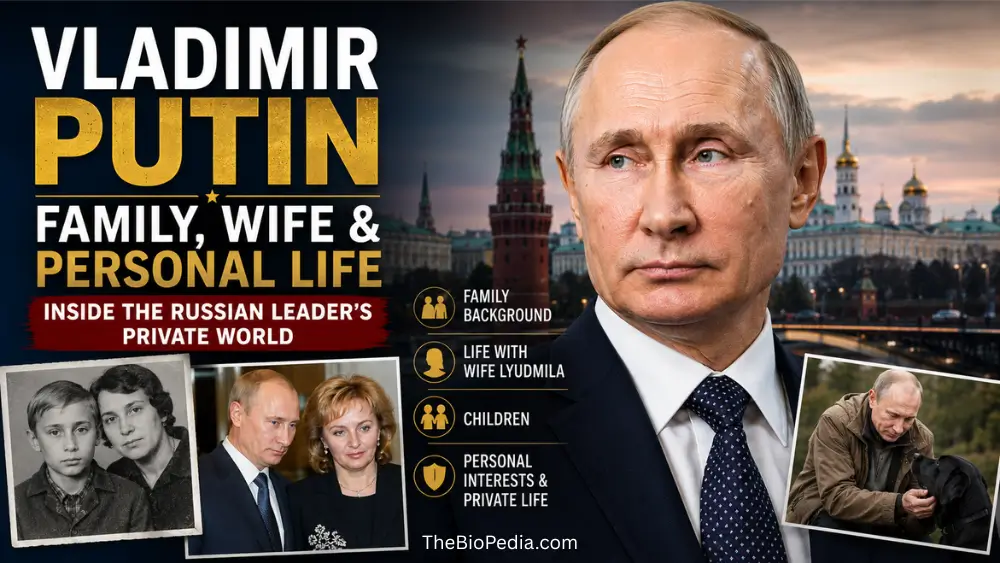
Vladimir Putin is, by any measure, one of the most scrutinized public figures on the planet. Every speech he delivers, every diplomatic meeting he conducts, and every military decision he makes is dissected by governments, analysts, journalists, and the global public. Yet in a remarkable paradox — one that is itself a deliberate product of careful management — the personal life of Vladimir Putin remains among the most opaque of any major world leader.
Unlike many heads of state who deploy family imagery as a tool of political communication, Putin has consistently kept his family life behind a wall of official silence. His daughters are rarely named in official communications. His divorce was announced without detail. His relationships beyond his marriage — reported by investigative outlets but never officially confirmed — exist in a grey zone of rumour and unverifiable allegation. His official residences are palaces of political symbolism rather than domestic warmth.
This carefully maintained privacy is not accidental. It reflects both genuine security concerns — in a world where association with Putin carries significant personal risk — and a deliberate political philosophy that presents the Russian president as a figure of state rather than a family man. Power, in Putin’s world, does not share space with personal vulnerability.
This article brings together everything that is publicly confirmed, reliably reported, or officially documented about Vladimir Putin’s family, wife, children, personal beliefs, hobbies, and lifestyle — maintaining clear distinctions between verified information and media allegations, and treating the subject with the factual rigour that a topic of this sensitivity demands.
For a complete overview of Putin’s life — including his political career and estimated net worth — read our comprehensive Vladimir Putin Biography: Age, Early Life, Political Career, Family & Net Worth.
Contents
Quick Facts About Vladimir Putin’s Personal Life
The following table provides a concise reference guide to the confirmed key facts about Putin’s personal life and family:
| Category | Details |
| Full Name | Vladimir Vladimirovich Putin |
| Date of Birth | October 7, 1952, Leningrad (now Saint Petersburg), Russia |
| Former Wife | Lyudmila Putina (née Shkrebneva) — married July 1983, divorced 2014 |
| Children | Two daughters: Maria Vladimirovna (b. 1985) and Katerina Vladimirovna (b. 1986) |
| Relationship Status | Divorced; current personal life officially undisclosed |
| Religion | Russian Orthodox Christian |
| Languages | Russian (native), German (fluent), English (conversational) |
| Hobbies | Judo (8th Dan black belt), ice hockey, skiing, fishing, horse riding, swimming |
| Key Personal Trait | Intense emphasis on privacy regarding family and personal relationships |
Family Background & Parents
To understand Vladimir Putin the man, one must understand the family that shaped him — a working-class Soviet family defined by hardship, patriotism, loss, and the particular kind of resilience that post-war Leningrad demanded of its inhabitants.
Vladimir Putin’s Father
Putin’s father, Vladimir Spiridonovich Putin, was born in 1911 in the village of Pominovo in the Tver region of Russia — a rural background that placed the family firmly among Russia’s working-class roots. He served in the Soviet Navy prior to World War II and was later conscripted into the NKVD — the Soviet secret police and predecessor to the KGB — during the war itself.
Vladimir Spiridonovich fought in the defence of Leningrad during the devastating siege, serving in a destroyer battalion tasked with harassing German positions. He was seriously wounded during the fighting — an injury that left lasting physical damage and that he carried for the rest of his life. His wartime service and sacrifice were points of deep family pride and shaped the elder Putin’s view of duty, country, and the obligations of a Soviet citizen.
After the war, Putin’s father worked as a factory foreman at a railway carriage manufacturing plant — steady, unglamorous work that placed the family in the respectable working-class stratum of Soviet Leningrad. He was, by accounts from those who knew him, a stern and disciplined man — qualities that his son absorbed and replicated. Vladimir Spiridonovich Putin died in 1999, shortly before his son became President of Russia.
Vladimir Putin’s Mother
Maria Ivanovna Putina (née Shelomova), Putin’s mother, was in many ways the emotional and spiritual heart of the family. Born in 1911, she endured the Siege of Leningrad — one of history’s most harrowing civilian ordeals — with extraordinary fortitude. She worked throughout the war in factory and manual labour jobs, surviving severe food shortages and the near-constant threat of bombardment.
Her husband fell seriously ill during the siege, and Maria’s determination kept the family together through conditions that many did not survive. Two older sons — Viktor, who died shortly after birth, and Albert, who died from diphtheria during the siege — preceded Vladimir, making him the family’s only surviving child. By all accounts, she poured immense devotion into raising him.
Despite the officially atheistic ideology of the Soviet state, Maria Putina maintained a quiet but sincere Russian Orthodox Christian faith — secretly having her son Vladimir baptised as a child and nurturing in him a religious sensibility that would later become a public and politically significant aspect of his identity. Putin has spoken of his mother with evident warmth and reverence in interviews and has credited her with instilling in him both spiritual faith and fundamental values of decency and resilience. She died in 1998, also before his presidency began.
Childhood Family Environment
The Putin family lived in a kommunalka — a communal apartment typical of Soviet working-class urban life — in Leningrad. The arrangement involved sharing a building, kitchen, and bathroom with other families: cramped, lacking in privacy, and requiring a particular kind of social navigation that comes from living in close proximity to people who are not family. It was, by any Western standard, a life of real material privation.
Post-war Leningrad was still visibly scarred when Putin was born in 1952 — bomb-damaged buildings, shortages of goods, the psychological weight of a city that had lost hundreds of thousands of its residents to the siege. The Soviet state’s narrative of heroic sacrifice and collective resilience was not abstract propaganda in this environment; it was a lived reality, present in the adults around the young Putin and embedded in the physical fabric of the city.
Putin has spoken about his childhood with apparent equanimity rather than resentment — framing the hardships of his early life as character-forming rather than damaging. The emphasis on discipline, toughness, and self-reliance that characterized his upbringing in this environment has remained visible throughout his adult life, in everything from his commitment to martial arts to his governing philosophy. Saint Petersburg — Leningrad — is not merely Putin’s birthplace; it is the psychological foundation upon which everything else was built.
For the full account of Putin’s upbringing, Soviet education, and KGB recruitment, read our article Vladimir Putin Early Life & KGB Career: How He Entered Russian Politics.
Marriage to Lyudmila Putina
How Vladimir Putin Met Lyudmila
Vladimir Putin met Lyudmila Shkrebneva in Leningrad in the late 1970s, introduced through a mutual friend. At the time, Lyudmila was working as a flight attendant for Aeroflot — the Soviet national airline — a job that gave her a cosmopolitan quality unusual in the relatively insular social world of Soviet Leningrad. She had grown up in Kaliningrad, the Russian exclave on the Baltic Sea, and was described by contemporaries as warm, outgoing, and sociable — in many respects a temperamental counterpoint to the reserved and private Putin.
Their courtship lasted approximately three years — longer than might be expected given the social norms of Soviet-era Russia — during which Putin was already working for the KGB’s Leningrad directorate. The specific details of their relationship during this period are sparse; Putin’s KGB career made him someone who was trained to share nothing unnecessarily, and Lyudmila’s later accounts of the early years of their relationship have been limited by the constraints of being the wife, and later the ex-wife, of Russia’s most powerful man.
The couple married in July 1983, in a ceremony in Leningrad. Putin was 30 years old; Lyudmila was 24. The marriage began under the shadow of KGB professional demands — Putin’s intelligence work meant irregular hours, constrained social life, restricted travel, and the kinds of confidentiality obligations that make normal married intimacy difficult. Lyudmila has spoken in interviews about the early years of their marriage being shaped by the particular pressures of life as the wife of a serving intelligence officer.
Life During the KGB Years
The defining logistical challenge of the Putin marriage’s early years was the posting to Dresden, East Germany from 1985 to 1990. Lyudmila accompanied her husband to East Germany — an experience that was in some ways an adventure and in others a profoundly isolating one. Life in the KGB compound in Dresden was circumscribed: Soviet families lived in a self-contained world, socializing primarily with other Soviet officials and their families, with limited contact with the East German population and essentially no contact with the West.
Lyudmila later wrote a memoir — published in German and Finnish but never officially released in Russia — that described her years in East Germany with some candour. She wrote of loneliness, of the difficulty of learning German, of the particular isolation of being a Soviet woman in a foreign country with young children. The two daughters — Maria, born in 1985, and Katerina, born in 1986 — were both born during the Dresden posting, making their earliest years ones spent in a foreign country under the specific conditions of Soviet intelligence family life.
Putin has said relatively little about his domestic life during this period. What is clear from Lyudmila’s accounts and other sources is that the marriage, while functional, was shaped from the beginning by Putin’s professional priorities, his emotional reserve, and the demands of a career that did not accommodate the ordinary architecture of family life in any straightforward way.
Public Appearances as First Lady
When Putin became Acting President of Russia in December 1999 and then President in May 2000, Lyudmila was elevated — reluctantly, by most accounts — to the role of First Lady. It was a role she appeared to find uncomfortable. Her public appearances were infrequent, often visibly nervous, and contrasted sharply with the carefully managed confidence of her husband. She attended state ceremonies, accompanied Putin on some international trips, and made the required public appearances of a head of state’s spouse, but she never developed a public persona of her own or a platform around which to build a visible First Lady identity.
Observers noted from an early stage that Lyudmila seemed uncomfortable in the spotlight. She gave occasional interviews that were sometimes notable for their unusual candour — at one point describing the presidency as having essentially ended her marriage as a normal domestic relationship. She occupied the role of First Lady without being consumed by it, maintaining a degree of personal authenticity that, paradoxically, made her a more sympathetic figure than a more polished performance might have done.
As Putin’s presidency progressed, Lyudmila’s public appearances became increasingly rare. By the time of his third presidential term, she had effectively withdrawn from public life almost entirely — appearing at major state occasions only when the protocol demands were unavoidable. The couple’s relationship had, by the accounts of those closest to both of them, effectively ended long before the formal divorce announcement.
Vladimir Putin’s Divorce and Life After Marriage
Announcement of the Divorce
On June 6, 2013, Vladimir Putin and Lyudmila appeared together in a brief, televised exchange following a ballet performance at the Kremlin — a setting that lent the announcement a peculiarly staged quality. Speaking directly to camera with the composed formality of a joint press release rather than an intimate admission, both Putin and Lyudmila confirmed that their marriage was over. Putin stated that their marriage was essentially finished, attributing it to the nature of his work and their different temperaments. Lyudmila confirmed that the decision was mutual.
The announcement was notable for what it lacked as much as what it contained: no apparent emotion, no detail about the circumstances, no indication of when the breakdown had occurred, and no information about what post-divorce life would look like for either party. It was, in the fullest sense, a managed communication — conveying the minimum required information with the maximum possible control over the narrative.
The divorce was formally completed in April 2014. Russian divorce law required the matter to go before a court, which it did, with the proceedings conducted with minimal publicity. The financial terms of the settlement — covering the assets of a man whose true wealth is among the most debated subjects in the world — have never been publicly disclosed. Lyudmila received an undisclosed settlement and, reportedly, Putin’s former official dacha in the Moscow region, among other assets.
Maintaining Privacy
Since the divorce, Lyudmila has maintained an almost total absence from public life. She has not given significant interviews, has not appeared at political events, and has resisted what would have been considerable public interest in her personal circumstances. Reports have occasionally surfaced — including suggestions that she remarried — but these have not been officially confirmed, and Lyudmila herself has not addressed them publicly.
This post-divorce silence is, in an important sense, consistent with the way the Putin family has always handled private matters: through the disciplined application of non-disclosure. Whether this silence is genuinely voluntary or reflects the particular pressures of being the ex-wife of Russia’s most powerful man — in a country where those close to Putin’s personal circle operate under significant informal constraints — is a question that cannot be answered with the information currently available.
Putin himself has not publicly discussed his post-divorce personal life. Reports in Western media — particularly from investigative outlets — have alleged romantic relationships with prominent Russian women, including former Olympic gymnast Alina Kabaeva, who has been linked to Putin for over a decade. These reports have never been officially confirmed; Putin has dismissed questions about his personal life curtly, and Russian state media largely avoids the subject.
Vladimir Putin’s Children and Daughters
How Many Children Does Vladimir Putin Have?
Vladimir Putin has two officially acknowledged daughters, both born during his posting in Dresden, East Germany: Maria Vladimirovna Putin (born 1985) and Katerina Vladimirovna Tikhonova (born 1986). For most of Putin’s presidency, the existence of his daughters was officially unacknowledged in Russian government communications — an extraordinary level of privacy for a head of state that reflected both genuine security concerns and Putin’s broader philosophy of keeping family entirely separate from political life.
Their identities were established and reported by investigative journalists — most prominently by Reuters and by various European investigative outlets — rather than through any official disclosure. Putin has occasionally referred obliquely to his daughters in interviews, but has steadfastly refused to name them publicly, discuss their lives, or acknowledge their professional activities, citing security concerns and a desire to protect them from the exposure that comes with his position.
Reports in investigative media have alleged the existence of additional children, including children from relationships with other women. These reports have not been officially confirmed and are based on investigative inference rather than documented evidence. This article addresses only what is publicly confirmed or reliably reported by credible investigative outlets.
Education and Professional Careers
Maria Vladimirovna Putin — sometimes reported under the married name Vorontsova — was born in Dresden in 1985 and is the elder of Putin’s two acknowledged daughters. She studied biology and later medicine, reportedly completing her medical training in Russia. Various investigative reports suggest she has been involved in the Russian healthcare sector, potentially connected to a company involved in medical research and endocrinology. She has been subject to Western sanctions — imposed by the United States, European Union, and United Kingdom — as part of the broader sanctions regime targeting Putin’s family and associates, on the basis that she has benefited from her father’s position.
Katerina Vladimirovna Tikhonova — also reported under the surname Putin — was born in Dresden in 1986 and is the younger daughter. Reports by Reuters, the BBC, and various investigative outlets have linked her to significant business interests in Russia, including in the technology and artificial intelligence sector, and to academic positions at Moscow State University. She is also reported to have been a competitive acrobatic rock and roll dancer at an international level — a detail that attracted considerable attention given the contrast with the official silence surrounding her identity. She has also been subject to Western sanctions.
The professional trajectories described above are based on investigative reporting rather than official disclosure. Neither daughter has made public statements about her work or life, and the Kremlin has neither confirmed nor denied specific details about their activities.
Why Putin Keeps His Family Private
Putin’s insistence on keeping his family entirely out of public life is one of the most consistent and non-negotiable aspects of his personal philosophy. He has offered several explanations over the years, all of which contain genuine elements: the security argument — that publicly identifying his family members makes them targets for adversaries; the privacy argument — that his children did not choose public life and should not be subjected to its costs; and the precedent argument — that mixing family and politics creates vulnerabilities that he is unwilling to accept.
There is also a more strategic dimension. By keeping his family entirely private, Putin maintains a separation between the personal and the political that insulates him from a particular kind of vulnerability — the humanizing, and therefore potentially weakening, effect that family imagery can have on a leader who wishes to project implacable strength. Leaders who display family warmth invite emotional engagement; Putin’s public persona is constructed around something altogether cooler and more formidable.
The practical consequences of this philosophy have been significant. Despite being among the most photographed and documented individuals on earth, Putin has successfully kept his daughters’ lives almost entirely shielded from public view for over two decades of presidency — a remarkable achievement in the age of social media and investigative journalism that reflects both the resources available to protect presidential privacy in Russia and the effectiveness of his personal commitment to maintaining it.
Vladimir Putin’s Hobbies and Interests
Putin’s hobbies and leisure activities are among the most carefully managed — and frequently photographed — aspects of his public persona. They serve a dual function: they are genuine personal interests that he has maintained throughout his adult life, and they are a deliberate element of the strongman image that is central to his political brand.
Judo and Martial Arts
Judo is perhaps the single most important extracurricular element of Putin’s life and identity. He began training in sambo — a Soviet martial art — at around age 10, before switching to judo at approximately 11. He trained seriously and competitively through his teenage years and university period in Leningrad, achieving a black belt and competing at a regional level. His commitment to the sport has never wavered: he has continued training throughout his intelligence career, his years in local politics, and his presidency.
Putin holds an 8th Dan black belt in judo — one of the sport’s highest grades — and has been an honorary president of the International Judo Federation, a role that was suspended (though not permanently revoked) following Russia’s 2022 invasion of Ukraine. He co-authored a book on judo technique — “Judo: History, Theory, Practice” — published in 2004, which provides both technical instruction and a window into the philosophical dimension of the sport that clearly resonates with him personally.
The influence of judo on Putin’s political style has been widely noted by analysts. The sport’s philosophy — using an opponent’s force against them, patience over aggression, leverage over raw power, mental composure under physical pressure — maps onto a governing approach that consistently emphasizes strategic patience, the exploitation of adversarial weaknesses, and the preference for manoeuvre over direct confrontation where possible. Putin himself has drawn these connections explicitly in interviews.
Ice Hockey and Sports
In addition to judo, Putin is a publicly enthusiastic ice hockey player — a sport he took up relatively late in life but has pursued with characteristic seriousness. He participates regularly in what are presented as informal hockey matches, typically featuring a roster of former professional players, current officials, and carefully selected business figures. These games — which Putin invariably plays with evident enjoyment and which he invariably wins by impressive goal margins — have attracted considerable scepticism about their competitive integrity.
Whatever their sporting authenticity, the hockey matches serve a clear political purpose: they project the image of a physically vigorous, athletically capable leader who plays hard and wins. The symbolism of ice hockey — a quintessentially Russian sport associated with national pride, physical toughness, and competitive excellence — reinforces the broader political messaging of Putin’s persona. The carefully staged nature of these events does not diminish their communicative effectiveness.
Beyond hockey, Putin maintains a serious general fitness regimen. He is reported to swim regularly — reportedly covering long distances — and to engage in a range of physical activities that reinforce the public image of someone who has not allowed the demands of political office to compromise his physical condition. The contrast with many Western leaders of his age is deliberate and effective.
Outdoor Activities
Putin’s outdoor activities have generated some of the most iconic — and most parodied — imagery of his presidency. He has been photographed fishing bare-chested in Siberian rivers, hunting in the Tyva region, horse riding in the mountains, skiing at Russian resorts, and scuba diving to “discover” ancient artefacts on the Black Sea floor. These images are produced by the Kremlin’s communications team and distributed globally as part of a consistent programme of cultivating Putin’s strongman persona.
The fishing and hunting imagery connects Putin to a specifically Russian tradition of masculine engagement with the natural world — evoking the great spaces and wild landscapes that are central to Russian national identity and cultural mythology. The horseback riding images, which attracted particular international attention and mockery for their deliberately virile staging, communicate physical dominance and an affinity with the kind of pre-modern masculinity that Putin’s political brand consistently invokes.
Whether these activities reflect genuine personal enjoyment — which they likely do, to a significant degree — or are primarily communication exercises — which they also clearly are — is in some sense a false dichotomy. Putin’s personal tastes and his political messaging have been so thoroughly aligned over decades that separating the authentic from the strategic is essentially impossible. What is clear is that outdoor life, physical activity, and engagement with Russia’s natural landscape are consistent themes in how he presents himself to the world.
Religion, Beliefs & Personal Values
Religious Background
Vladimir Putin identifies publicly as a Russian Orthodox Christian — a commitment that, whatever its personal depth, has become one of the most politically significant dimensions of his public identity. His mother, Maria Ivanovna, was a quietly devout Orthodox believer who had him baptised secretly as an infant — a meaningful act in the officially atheistic Soviet Union, and one that Putin has described as among the most important things she did for him.
Putin has spoken about his faith in interviews with what appears to be genuine personal engagement, describing his belief in God in terms that go beyond mere political signalling. He has recounted a story of rescuing his baptismal cross from a house fire and taking it to Jerusalem to be blessed — a detail that, whether precisely accurate or not, is consistent with the kind of devotional attachment he claims to the Orthodox tradition.
His relationship with the Russian Orthodox Church has been one of the defining institutional relationships of his presidency. Patriarch Kirill — head of the Russian Orthodox Church since 2009 — and Putin have cultivated a mutually reinforcing partnership in which the Church provides ideological legitimacy for the Putin political project, framing Russian national values, opposition to Western liberal influence, and even the invasion of Ukraine in theological terms. Critics have described this partnership as a corruption of the Church’s pastoral mission in service of political authority — a charge that Patriarch Kirill has rejected.
Orthodox Christianity’s emphasis on tradition, hierarchy, community over individualism, and the primacy of the spiritual and national collective over liberal democratic universalism aligns naturally with the political philosophy Putin has articulated across his years in power. Whether this alignment reflects deep personal belief, calculated political strategy, or — most likely — both simultaneously, the Orthodox Church has become an indispensable element of the ideological architecture of Putinism.
Personal Philosophy
Putin’s personal philosophy — insofar as it can be reconstructed from interviews, speeches, and the documented pattern of his decisions — is built around several core values that trace back to his childhood and intelligence career. Patriotism, in the specifically Russian sense of attachment to state, territory, and national civilizational distinctiveness, is perhaps the most fundamental. Putin does not appear to separate his personal identity from his identity as a Russian — the two are, for him, inseparable.
Discipline — physical, mental, and professional — is another consistent value. From his teenage commitment to judo training to his KGB career to his management of the Russian presidency, Putin has displayed a consistent preference for order, structure, and the mastery of the self as prerequisites for the mastery of anything else. This discipline is not merely performative; it appears to reflect a genuinely internalized code of conduct that has guided him across very different contexts.
His emphasis on sovereignty — Russia’s right to determine its own course free from external interference — is the philosophical foundation of his foreign policy and reflects a worldview formed partly by the humiliation of Russia’s post-Soviet weakness and partly by the KGB’s training in the primacy of state security. And his deep suspicion of what he characterizes as Western cultural imperialism — particularly the promotion of liberal values around individual rights, gender identity, and democratic universalism — reflects a socially conservative personal philosophy that has hardened into state policy across his years in power.
Vladimir Putin’s Public Image and Lifestyle
Carefully Managed Public Persona
Perhaps no element of Putin’s presidency has been more deliberately constructed than his public persona. From the earliest days of his first term, the Kremlin’s communications operation has produced a consistent, carefully managed image: a physically formidable, emotionally controlled, intellectually serious, and patriotically committed national leader who combines the discipline of an intelligence officer with the vigour of an athlete and the conviction of a believer.
This persona has been maintained through a combination of carefully controlled media access, the production of staged imagery (the fishing trips, the hockey matches, the judo sessions), the management of public appearances for maximum symbolic impact, and the systematic suppression of alternative narratives — whether through legal pressure on independent media or the more direct methods occasionally documented by investigative journalists.
The annual Direct Line — a live television event in which Putin takes questions from Russian citizens for hours at a stretch, displaying encyclopaedic command of government data and individual cases — is perhaps the most elaborately staged regular performance of his persona: the approachable but authoritative leader, fully in command of the detail, responsive to ordinary Russians while projecting comprehensive mastery. Critics note that the questions are curated and the event meticulously prepared; supporters point to its effectiveness as political communication.
Internationally, Putin’s brand as a leader of formidable intelligence, strategic patience, and ruthless pragmatism has been cultivated through decades of diplomatic interactions in which he has consistently demonstrated preparation, precision, and the capacity to wrong-foot interlocutors who underestimate him. The perception of him as a master strategist — whatever its actual accuracy in any specific context — is itself a diplomatic asset.
Presidential Residences and Security
Putin’s official residences include the Grand Kremlin Palace in Moscow — the historic seat of Russian political power — and Novo-Ogaryovo, the presidential estate outside Moscow that serves as his primary working and private residence. He also uses Bocharov Ruchei, the presidential residence on the Black Sea near Sochi, for summer residency and diplomatic meetings. These are official state properties, maintained at state expense.
Beyond these official residences, investigative reporting — most prominently the Navalny Foundation’s 2021 documentary — has alleged the existence of a vast private palace on the Black Sea coast near Gelendzhik, described as a personal residence for Putin featuring luxury amenities including a casino, theatre, and private beach on a heavily secured compound reportedly valued at over one billion dollars. The Kremlin has denied that the property belongs to Putin, and no official confirmation of his ownership has been established.
Putin’s personal security arrangements are among the most extensive in the world, reflecting both the genuine risk environment faced by a leader in his position and the broader culture of protective isolation that has surrounded him throughout his presidency. His security detail — drawn from the Federal Protective Service (FSO) — numbers in the thousands, and his movements are conducted under conditions of extreme operational security. This security apparatus is both a practical necessity and a contributor to the physical and psychological isolation from ordinary reality that analysts have increasingly noted as a characteristic of his later presidency.
Global Recognition
Whatever the moral assessment of his governance, Vladimir Putin is one of the most globally recognized political figures of the 21st century. His face, his name, and his distinctive manner are known to billions of people across every continent — a recognition driven by his decades of prominence, the dramatic nature of his international interventions, and the global media attention that his decisions have consistently attracted.
This recognition carries different valences in different contexts. In Russia and among those who share his scepticism of Western liberal dominance, he is a symbol of restored national pride and unapologetic sovereignty. In Ukraine and much of the Western world, he is associated with aggression, lawlessness, and the violation of the international norms that have underpinned European security since 1945. In the Global South and among nations that have sought to position themselves outside the US-Russia binary, the assessment is more ambivalent — recognizing Russia’s geopolitical weight while not necessarily endorsing its methods.
His political brand — the strongman who speaks for national sovereignty and civilizational distinctiveness against Western universalism — has been explicitly studied, imitated, and invoked by nationalist political movements across Europe, Latin America, and beyond. For better or worse, Putinism as a political model has had a reach far beyond Russia’s borders, shaping the vocabulary and the aspirations of authoritarian and populist movements worldwide.
Interesting Facts About Vladimir Putin’s Personal Life
Here are some revealing and lesser-known facts about Putin’s personal life, habits, and character:
- Began Judo at Age 11: Putin’s judo career began in a Leningrad training hall when he was 11 years old — a commitment that has never wavered and that he has maintained for over six decades, earning an 8th Dan black belt.
- Speaks Fluent German: As a direct result of his five-year KGB posting in Dresden, East Germany, Putin speaks German well enough to use it in diplomatic and professional settings without an interpreter — a skill he has demonstrated publicly on multiple occasions.
- Published Author on Martial Arts: Putin co-authored a book on judo — “Judo: History, Theory, Practice” — published in 2004. It covers both technical aspects of the sport and its philosophical dimensions, offering a rare window into an aspect of his thinking he discusses with genuine enthusiasm.
- His Daughters Were Born in East Germany: Both of Putin’s officially acknowledged daughters — Maria (1985) and Katerina (1986) — were born during his KGB posting in Dresden, East Germany, making them citizens of a country that no longer exists.
- His Mother Baptised Him in Secret: In a significant act of religious defiance against Soviet atheism, Putin’s mother had him secretly baptised as a Russian Orthodox Christian in infancy — a fact he has described as one of the most important gifts she gave him.
- Attended Ballet the Night of His Divorce Announcement: The public announcement of Putin’s divorce from Lyudmila was made in a brief exchange following a ballet performance at the Kremlin — a characteristically choreographed setting for a disclosure that was managed with the precision of a political operation.
- Has Never Publicly Named His Daughters: Despite over 25 years as a national leader, Putin has never officially confirmed the names of his daughters in a public statement — an extraordinary level of family privacy for one of the world’s most scrutinized individuals.
- Reportedly Swims Long Distances Daily: Putin is reported to swim for significant distances — reportedly up to 1,000 metres — as part of a daily fitness routine maintained throughout his presidency, complementing his judo training and general physical regimen.
FAQs
Who is Vladimir Putin’s wife?
Vladimir Putin’s former wife is Lyudmila Putina (née Shkrebneva), who was born in 1958 in Kaliningrad. The couple met in Leningrad in the late 1970s and married in July 1983. Their divorce was publicly announced in June 2013 during a brief, staged television exchange, and was formally completed in April 2014. Since the divorce, Lyudmila has maintained an almost complete absence from public life, and no reliable public information about her current circumstances is available. Putin has not publicly discussed his personal life since the divorce.
Does Vladimir Putin have children?
Yes. Vladimir Putin has two officially acknowledged daughters: Maria Vladimirovna Putin (born 1985, also reported under the name Vorontsova) and Katerina Vladimirovna Tikhonova (born 1986). Both were born in Dresden during Putin’s KGB posting in East Germany. Both have been subject to Western sanctions as part of the sanctions regime targeting Putin’s family and associates. Putin has never officially named his daughters in public statements, and details of their professional activities come from investigative journalism rather than official disclosure.
How many daughters does Vladimir Putin have?
Vladimir Putin has two officially acknowledged daughters — Maria and Katerina — both born during his KGB posting in Dresden, East Germany, in the mid-1980s. Investigative media reports have alleged the possible existence of additional children from other relationships, but these claims have not been officially confirmed and remain unverified. Putin himself has never publicly named his daughters or discussed their lives in official communications.
Why is Putin’s family rarely seen in public?
Putin’s family is rarely seen in public due to a combination of genuine security concerns, deliberate political strategy, and what appears to be a deeply held personal philosophy about the separation of private and political life. As the leader of a nuclear power with numerous adversaries, Putin has consistently argued that exposing family members publicly creates security vulnerabilities. Beyond the security rationale, keeping family entirely private reinforces his carefully managed persona as a figure of state rather than a family man — an image of power that is not softened by domestic warmth or personal vulnerability.
What hobbies does Vladimir Putin have?
Vladimir Putin’s hobbies include judo (which he has practiced since age 11 and in which he holds an 8th Dan black belt), ice hockey, swimming, skiing, horse riding, fishing, and hunting. He has maintained a serious physical fitness regimen throughout his adult life, and his recreational activities are an important part of his carefully managed public persona — projecting the image of a physically vigorous, disciplined, and quintessentially Russian leader. He is also a co-author of a book on judo technique and has been an honorary president of the International Judo Federation.
What religion is Vladimir Putin?
Vladimir Putin identifies as a Russian Orthodox Christian. He was secretly baptised as an infant by his mother despite the officially atheistic Soviet state, and has described his faith as a genuine personal commitment rather than a merely political affiliation. His relationship with the Russian Orthodox Church — and its leader, Patriarch Kirill — has been one of the defining institutional relationships of his presidency. The Church has provided ideological legitimacy for many aspects of the Putin political project, including the framing of Russian national values and, controversially, the theological justification offered by Patriarch Kirill for the war in Ukraine.
Conclusion
Vladimir Putin’s personal life is, ultimately, a study in deliberate concealment — not the concealment of shame, but the concealment of strategic choice. A man who has spent his entire adult life understanding the relationship between information and power has applied that understanding to his own biography with extraordinary consistency. His family is protected from view. His relationships are officially unacknowledged. His private beliefs are shared selectively and on his own terms.
What does emerge from the verified record is a portrait of a man shaped by hardship, defined by discipline, and guided by values — patriotism, sovereignty, toughness, and faith — that were formed in post-war Leningrad and the KGB, and that have never fundamentally changed. His marriage followed and then could not survive the demands of a life in which the state always came first. His daughters were raised in the shadow of that same priority. His hobbies and his faith are the private architecture of a public figure who allows very little of the private to become public.
Understanding Putin’s personal life — even imperfectly, even incompletely — is essential to understanding the man who has shaped Russia’s trajectory for a quarter of a century. The private informs the public in ways that are more profound, and more consequential, than any official biography will ever fully acknowledge.
Continue Reading Articles on Vladimir Putin:
For the complete story of Putin’s life, read our Vladimir Putin Biography
For his origins in Soviet intelligence, read Vladimir Putin Early Life & KGB Career
For the full political story, read Vladimir Putin Political Career Timeline
For his finances, read Vladimir Putin Net Worth & Assets: Salary, Wealth, Luxury Homes & Influence