
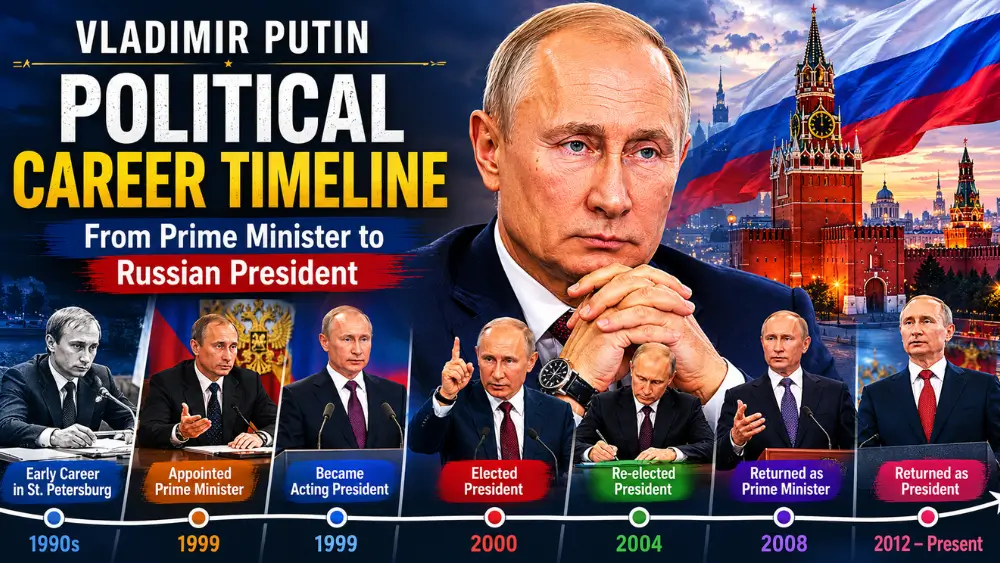
In the history of modern political leadership, few careers have been as deliberately constructed — or as consequential — as that of Vladimir Putin. His rise from a relatively obscure government administrator in Saint Petersburg to the dominant force in Russian politics for more than two decades is not a story of fortunate coincidence. It is a story of calculated patience, institutional loyalty, intelligence-trained discretion, and a clear-eyed understanding of how power works in the turbulent post-Soviet Russian state.
The Vladimir Putin political career timeline spans more than three decades of unbroken relevance: from his first advisory role in Saint Petersburg’s city government in the early 1990s, through a rapid ascent in Moscow’s federal institutions, to his appointment as Prime Minister, his assumption of the Russian presidency, and his transformation of that office into a vehicle for one of the most durable personal political dominions in the democratic world’s recent history.
Understanding this timeline is essential for anyone seeking to understand modern Russia. Putin did not merely occupy political positions — he reshaped each institution he led and used each role as a platform to build toward the next. His career is a masterclass in political consolidation, and its arc tells us as much about the structural vulnerabilities of post-Soviet Russia as it does about the man himself.
This article provides a detailed, chronological account of Vladimir Putin’s political career — from his earliest steps in public service to his fifth presidential term, mapping every significant milestone along the way.
For the full context of Putin’s life — including his childhood, family, and estimated net worth — read our comprehensive Vladimir Putin Biography: Age, Early Life, Political Career, Family & Net Worth.
Contents
Quick Timeline Overview: Vladimir Putin’s Political Career
The following table provides a fast-reference overview of the key milestones in Vladimir Putin’s political career — from his KGB years through to his current presidency:
| Year / Period | Key Political Event |
| 1975 | Joined the KGB after graduating from Leningrad State University |
| 1985–1990 | Posted to Dresden, East Germany as a KGB intelligence officer |
| 1990–1991 | Returned to Leningrad; resigned from KGB following Soviet collapse |
| 1990–1996 | Advisor then Deputy Mayor of Saint Petersburg under Mayor Sobchak |
| 1996 | Moved to Moscow; joined the Kremlin Presidential Administration |
| 1998 | Appointed Director of the Federal Security Service (FSB) |
| Aug 1999 | Appointed Prime Minister of Russia by President Boris Yeltsin |
| Dec 31, 1999 | Boris Yeltsin resigned; Putin became Acting President of Russia |
| Mar 2000 | Won presidential election with ~52.9% of the vote — First Term begins |
| 2004 | Re-elected President with 71.3% — Second Term |
| 2008–2012 | Served as Prime Minister under President Dmitry Medvedev |
| 2012 | Returned to presidency; won election with 63.6% — Third Term |
| 2014 | Annexed Crimea; Western sanctions imposed on Russia |
| 2018 | Re-elected President with 76.7% — Fourth Term |
| 2020 | Constitutional amendments reset term limits; potential to rule until 2036 |
| Feb 2022 | Launched full-scale invasion of Ukraine |
| Mar 2024 | Re-elected with 87.3% — Fifth Term begins |
Early Steps Into Politics
Leaving the KGB and Entering Public Service
Vladimir Putin’s transition from intelligence officer to politician was neither abrupt nor accidental. It was a carefully navigated shift that drew on the networks, skills, and reputation he had built during 16 years of KGB service. When the Soviet Union collapsed in 1991 and Putin resigned from the KGB at the rank of Lieutenant Colonel, he did not find himself adrift. He had, with characteristic forethought, already begun building his political contacts.
Returning to Leningrad — renamed Saint Petersburg in 1991 — Putin initially worked as an assistant to the rector of Leningrad State University, his alma mater. This was not a prestigious position, but it served a specific purpose: it gave him legitimate civilian credentials, a university affiliation, and the proximity to his former mentor that would prove decisive for his political future.
The post-Soviet transition period of the early 1990s was a moment of extraordinary political fluidity in Russia. Old institutional loyalties were dissolving, new power structures were forming, and the ability to navigate between them — with discipline, discretion, and a clear sense of one’s own positioning — was the decisive competitive advantage. Putin had all three in abundance.
Working Under Anatoly Sobchak
The pivotal relationship in Putin’s entry into politics was with Anatoly Sobchak — his former law professor at Leningrad State University, now one of the most prominent democratic reformers in Russia. Sobchak became Chairman of the Leningrad City Council in 1990 and Mayor of the newly renamed Saint Petersburg in 1991, and he brought Putin into his administration as an advisor on external relations.
Putin’s rise within Sobchak’s team was rapid. By 1994, he had been appointed First Deputy Mayor — one of the most senior positions in the city government — with responsibility for external relations, foreign investment, international partnerships, and liaison with federal authorities in Moscow. He oversaw complex negotiations between the city and foreign businesses eager to enter the Russian market during the transition period, gaining practical experience of the intersection between political power and economic interests that would prove invaluable later.
Sobchak’s administration was a politically diverse and intellectually lively environment — one that attracted future luminaries of Russian politics and business. Putin stood out not for ideological flair or public charisma, but for the qualities that would define his entire political career: reliability, competence, discretion, and an unwavering loyalty to those he served. He was known as someone who delivered on commitments, who did not draw unnecessary attention to himself, and who could manage the often murky intersection of business, politics, and organized crime that characterized Saint Petersburg in that era.
When Sobchak lost his re-election bid in 1996 — partly due to corruption allegations that would follow Sobchak’s administration, though Sobchak himself was later cleared — Putin declined to transfer his services to the new mayor. He chose loyalty over career convenience, a decision that cost him his position but, in the peculiar moral economy of Russian politics, significantly enhanced his reputation for trustworthiness among those who mattered in Moscow.
For the full story of Putin’s early life and KGB career that preceded his entry into politics, read our article Vladimir Putin Early Life & KGB Career: How He Entered Russian Politics.
Move to Moscow and Federal Politics
Transition to the Kremlin
Putin’s move to Moscow in 1996 marked the beginning of his transition from regional administrator to federal political figure. His reputation from Saint Petersburg — capable, loyal, discreet, effective — had reached the Kremlin, and he was brought into the Presidential Administration of Boris Yeltsin, initially in a role managing presidential property and later as Deputy Chief of the Presidential Administration.
Moscow in 1996 was a city in the grip of extraordinary political and economic turbulence. Yeltsin had won re-election that year despite serious health problems and an economy still reeling from the shock therapy reforms of the early 1990s. The presidential administration was a contested space of competing interests — oligarchs, security service veterans, reformist economists, and political operators all jostling for proximity to a president whose grip on power was visibly weakening.
Putin navigated this environment with the same qualities that had served him in Saint Petersburg — keeping his head down, building trust through performance, and avoiding the factional conflicts that consumed many of his contemporaries. His intelligence background gave him a particular advantage: he understood surveillance, he understood loyalty networks, and he understood that the most dangerous people in any political environment are those who reveal too much too soon.
Gaining Trust in Government
Putin’s advancement through the Moscow political hierarchy was unusually rapid — a speed that reflected both genuine ability and the turbulent nature of Yeltsin-era Russian politics, in which positions of significant responsibility were often filled by whoever combined competence with trustworthiness in a context where both were scarce.
In March 1997, Putin was promoted to Deputy Chief of the Presidential Administration — a genuinely senior role that placed him at the centre of the Kremlin’s operational machinery. He was responsible for relations between the federal government and Russia’s regional authorities, a portfolio that gave him insight into — and influence over — the complex web of regional political and economic power that would later become a target of his centralizing agenda as president.
By this stage, Putin had established himself as someone in whom Yeltsin’s inner circle — including the influential figures around Yeltsin’s family, sometimes known as “The Family” — had genuine confidence. He was not a political rival; he was a trusted executor. In an environment where political treachery was commonplace, that quality was of incalculable value. His star was rising.
Becoming Director of the FSB
Leadership of Russia’s Security Service
In July 1998, Vladimir Putin was appointed Director of the Federal Security Service — the FSB — Russia’s principal domestic security and counterintelligence agency, and the most direct institutional successor to the KGB. It was a role that aligned perfectly with his background, his instincts, and his institutional knowledge of Russia’s security apparatus.
The FSB under Putin underwent significant reorganization and a reassertion of institutional discipline. The 1990s had been a period of relative disarray for Russian security institutions — the collapse of the Soviet Union had disrupted funding, morale, and operational coherence. Putin moved to restore the FSB’s sense of purpose and its institutional standing within the Russian state. He reorganized its leadership, tightened internal discipline, and — crucially — used the role to build a network of FSB-aligned personnel that would, in years to come, be deployed across the Russian government and economy.
His tenure as FSB Director lasted just over a year — from July 1998 to August 1999 — but it was consequential far beyond its brevity. It gave Putin formal command of Russia’s most powerful domestic security instrument, deepened his already extensive network within Russia’s security community (the siloviki — men of force — who would become a defining constituency of his presidency), and demonstrated to Yeltsin’s inner circle that he could manage the most sensitive institutional levers of Russian state power.
The FSB role also placed Putin in charge of investigating corruption cases involving prominent figures — a responsibility that, in the right hands, was as much a political instrument as a law enforcement function. Putin’s management of this power — judiciously and without provocation of those he needed as allies — was itself a demonstration of political sophistication.
Appointment as Prime Minister
Why Boris Yeltsin Chose Putin
On August 9, 1999, Boris Yeltsin appointed Vladimir Putin as Prime Minister of Russia — his fifth prime minister in eighteen months — in a move that surprised most political observers. Putin was little-known to the Russian public: a capable technocrat with intelligence and security credentials, but not a national figure with an independent political identity or a public profile that suggested imminent national leadership.
Yet the choice made perfect sense within the specific logic of late-Yeltsin-era Russian politics. Yeltsin needed a successor who combined a specific set of qualities: loyalty, competence, security credentials, political neutrality relative to the major factional conflicts of the day, and the willingness to protect Yeltsin’s family and associates from prosecution after his departure. Putin checked every box.
Why Boris Yeltsin Selected Putin as His Successor:
- Absolute loyalty — Putin never publicly contradicted or undermined Yeltsin
- KGB discipline — his intelligence background meant he understood discretion and institutional loyalty
- Proven competence — his FSB directorship demonstrated administrative and security capability
- Political neutrality — he had no independent power base or rival political ambitions that threatened the Kremlin’s existing structure
- Chechnya credibility — his handling of the Second Chechen War gave him genuine public popularity and a strongman image
- Willingness to protect — implicit in the transition was an understanding that Putin would shield Yeltsin’s family and associates from prosecution
The appointment came at a moment of acute national crisis. Chechen insurgents had launched incursions into the neighbouring republic of Dagestan, the Russian economy was still recovering from the 1998 financial crash, and Yeltsin’s government was widely perceived as corrupt, ineffective, and exhausted. Putin’s response to these conditions would define his public image and, ultimately, his political destiny.
Challenges as Prime Minister
Putin’s tenure as Prime Minister was brief — just four months — but extraordinarily consequential. He faced three immediate challenges: responding to the Chechen insurgency in Dagestan; responding to a series of devastating apartment building bombings in Moscow and other Russian cities that killed nearly 300 people; and managing the political transition from a failing president to a new national leadership.
His response to the Chechen crisis was swift, unambiguous, and deliberately public. He ordered a full military campaign to drive insurgents from Dagestan and then extended the operation into Chechnya itself, launching what became the Second Chechen War. His language was blunt and aggressive — including a remark about pursuing terrorists “wherever we find them” that was widely noticed for its departure from the cautious diplomatic language of the Yeltsin years.
The apartment bombings — attributed by the government to Chechen terrorists, though the evidence has been disputed by some independent Russian journalists and analysts — further galvanized public opinion behind the new Prime Minister’s strong-state response. Putin’s approval ratings rose from relative obscurity to extraordinary heights within weeks of his appointment. By November 1999, polls showed him as the most popular political figure in Russia. The combination of a genuine security crisis, a decisive response, and a public exhausted by years of weakness and instability had created the conditions for a political phenomenon.
Becoming Acting President of Russia
Boris Yeltsin’s Resignation
On December 31, 1999 — New Year’s Eve — Boris Yeltsin made a surprise televised announcement that shocked Russia and the world: he was resigning as President of the Russian Federation, effective immediately. The resignation came three months before the scheduled end of his term and was framed by Yeltsin in terms of personal responsibility and the desire to hand over to a new generation of leadership. He asked the Russian people’s forgiveness for the failures of his decade in power.
The timing was not accidental. A New Year’s Eve announcement guaranteed maximum media coverage and placed Putin in a position to begin his acting presidency with the symbolic freshness of a new year and a new millennium. It also gave Putin three additional months as Acting President before the scheduled presidential election — time to establish incumbency, consolidate his political position, and present himself as the sitting leader of Russia to an audience both domestic and international.
Yeltsin’s final act as president was to sign a decree granting himself and his family immunity from future criminal prosecution — a provision that many observers saw as confirming the existence of a private understanding between the outgoing and incoming presidents about the terms of the transition.
Putin Assumes Leadership
Putin was sworn in as Acting President of Russia on December 31, 1999, within hours of Yeltsin’s resignation. His first acts were deliberately symbolic and substantive: he issued a decree formally granting Yeltsin immunity from prosecution, and he flew to Chechnya to visit Russian troops — a gesture of solidarity with the military and a statement about his priorities as a national leader.
The public response to Putin’s assumption of power was largely positive. Russians had been watching a confident, physically vigorous, clear-spoken leader handle a genuine security crisis with apparent effectiveness, and the contrast with the ailing Yeltsin was stark and favourable. While Western governments were cautious — and some were already concerned about democratic backsliding in Russia — the Russian domestic public reception was one of cautious but genuine optimism.
Putin’s acting presidency lasted approximately three months — a period during which he governed with the full powers of the presidency while preparing for the March 2000 election. He used the period effectively: building the image of decisive national leadership, managing the Chechen campaign, and ensuring that the political machinery of the Russian state was aligned behind his candidacy.
Winning the 2000 Presidential Election
Campaign and Public Support
Putin won the March 26, 2000 presidential election in the first round — avoiding a runoff — with approximately 52.9% of the vote. His nearest competitor, Communist Party candidate Gennady Zyuganov, received around 29%. The result was a clear first-round majority, and while international observers noted the election occurred in conditions that gave Putin significant incumbency advantages — including dominance of state television and the resources of the presidential apparatus — there was no serious dispute that Putin’s victory reflected genuine and substantial public support.
His campaign was less a conventional political campaign than a demonstration of incumbency. Putin largely declined to participate in formal debates, presenting himself as a working president rather than a candidate. His campaign materials were thin on policy specifics but rich in imagery of competent, vigorous national leadership. The contrast with the disorder and apparent weakness of the Yeltsin years was the central implicit message — and it resonated powerfully with a Russian electorate that had experienced a decade of economic hardship, political instability, and national humiliation.
Key elements of his public appeal at this stage included: the successful prosecution of the Second Chechen War; his youth and physical vigour compared to Yeltsin; his clear and direct communication style; his image as a serious, no-nonsense professional rather than a political performer; and a vague but powerful promise of restored Russian state authority and pride.
Beginning a New Political Era
Putin’s inauguration as President on May 7, 2000 marked the beginning of what would prove to be a fundamental transformation of the Russian political system. In his early weeks and months as president, he moved with deliberate speed to consolidate the instruments of political authority that had been dispersed, weakened, or captured by oligarchic interests during the Yeltsin years.
The early consolidation agenda included: restructuring Russia’s 89 regions into seven federal districts headed by Putin-appointed representatives; moving to bring major independent television networks under state-aligned ownership; launching legal proceedings against politically inconvenient oligarchs (most prominently Vladimir Gusinsky and Boris Berezovsky) while establishing an implicit understanding with others that business could proceed provided they stayed out of politics; and restructuring the Federation Council to reduce the political power of regional governors.
These moves were framed publicly as anti-corruption measures and the restoration of constitutional order — narratives that were partially accurate and entirely politically convenient. The underlying effect was to systematically reduce the independent power of any institution or individual capable of challenging Kremlin authority. The “managed democracy” that would define Putin’s Russia was being constructed from the first months of his presidency.
Putin’s First Two Presidential Terms (2000–2008)
Economic Growth and Reforms
The first two Putin presidential terms coincided with a period of genuine and substantial economic growth in Russia that transformed living standards for millions of citizens and restored a degree of national economic confidence that had been shattered by the crises of the 1990s. Real GDP grew at an average of approximately 7% per year between 2000 and 2008. Poverty rates fell dramatically — from approximately 29% of the population in 2000 to around 13% by 2008. Real wages roughly doubled over the same period.
The primary driver of this growth was the sustained rise in global oil and gas prices — from around $20 per barrel when Putin took office to over $140 per barrel at the peak in 2008. Russia’s economy was heavily dependent on hydrocarbon export revenues, and the commodity boom effectively funded everything else: rising public sector wages, pension increases, federal budget surpluses, and Russia’s accumulation of a substantial sovereign wealth fund. Putin was a direct political beneficiary of this economic improvement, and he understood the connection clearly.
His economic management also included genuine structural achievements: Russia paid off its Soviet-era foreign debts ahead of schedule, introduced a flat income tax rate of 13% that increased compliance and revenues, and brought a degree of macroeconomic stability to a country that had experienced hyperinflation and financial collapse within recent memory. The combination of commodity-driven prosperity and relative macroeconomic stability made the Putin era, for most ordinary Russians, a period of genuine material improvement.
Strengthening Central Government
Alongside economic growth, Putin’s first two terms were defined by a systematic strengthening of central government authority at the expense of regional autonomy, independent business interests, and civil society institutions. The abolition of elected regional governors following the 2004 Beslan school siege — replaced by presidential appointees — was the most dramatic single step in this centralizing agenda, but it was part of a consistent pattern that began in 2000 and continued throughout.
The political party system was restructured to ensure Kremlin dominance. United Russia — effectively Putin’s party — was built into a dominant political force that controlled legislative majorities at federal and regional levels. Electoral laws were adjusted in ways that raised barriers to opposition parties. Civil society organizations receiving foreign funding were subjected to increased scrutiny and legal pressure. The space for organized political opposition was systematically narrowed.
The message to Russia’s elite was equally clear. The Yukos affair — the arrest of oil oligarch Mikhail Khodorkovsky in 2003 and the subsequent renationalization of his company — served as an unambiguous signal that private economic power operating outside the Kremlin’s political framework would not be tolerated. Other oligarchs received the message: those who stayed out of politics and aligned their business interests with state priorities could operate; those who challenged Kremlin authority could not.
Expanding Russia’s Global Role
Putin used his first two presidential terms to begin the reassertion of Russia’s global role — a project that accelerated dramatically in his subsequent terms. His 2007 Munich Security Conference speech — in which he delivered a sharp critique of the US-dominated unipolar world order and NATO expansion — announced to the international community that Russia under Putin would be a revisionist power, unwilling to accept the post-Cold War settlement that had left Russia weakened and the West dominant.
Russia’s 2008 military intervention in Georgia — a brief but decisive five-day war that resulted in Russian recognition of South Ossetia and Abkhazia as independent states — provided the first concrete demonstration of Putin’s willingness to use military force to assert Russian interests in what Moscow considered its sphere of influence. The international response — criticism without consequence — was a lesson Putin drew on when planning subsequent interventions.
Prime Minister Again (2008–2012)
Constitutional Term Limits
The Russian constitution as it existed in 2008 limited presidents to two consecutive terms — a provision that Putin chose to respect, at least formally. Unable to serve a third consecutive presidential term, he stepped down from the presidency in May 2008 following the election of his chosen successor, Dmitry Medvedev, and accepted the position of Prime Minister under the new president.
The arrangement was widely understood — by Russians and international observers alike — as a formal constitutional manoeuvre rather than a genuine transfer of power. Putin remained the dominant figure in Russian politics throughout the Medvedev presidency. The Prime Ministership gave him continued executive authority over the day-to-day operations of government, while Medvedev provided the constitutionally necessary presidential face. The informal characterization of the arrangement as a “tandem” — with Putin as the senior partner — was accurate to the point of obviousness.
Serving Under Dmitry Medvedev
Medvedev’s presidency (2008–2012) was characterized by somewhat more moderate rhetoric — particularly on relations with the West and on domestic liberalization — than either the preceding or succeeding Putin terms. Medvedev spoke publicly about the need to modernize Russia’s economy and diversify away from commodity dependence, and his foreign policy approach was sufficiently distinct from Putin’s to generate some genuine international engagement, including the New START arms reduction treaty with the United States.
Putin, however, remained in effective command of the state. Major decisions — particularly on security matters, energy policy, and strategic economic direction — were made with his involvement and endorsement. The separation between the Prime Ministerial and Presidential functions was more institutional than real. When Putin announced in September 2011 that he would return to the presidency in the 2012 election, Medvedev’s role in the arrangement became explicit: he had been a placeholder, managing constitutional formalities while Putin retained effective power.
The announcement of Putin’s return triggered significant public protests — the largest in Russia since the 1990s — with tens of thousands taking to the streets in Moscow and other major cities, expressing frustration at what was widely perceived as a staged constitutional manoeuvre. Putin’s response to these protests — eventually suppressing them through a combination of legal pressure, arrests of protest leaders, and new legislation restricting public demonstrations — set the tone for the more authoritarian character of his subsequent presidential terms.
Return to the Presidency (2012–Present)
2012 Election Victory
Putin was elected to his third presidential term in March 2012, receiving approximately 63.6% of the vote. The election was held against a backdrop of significant public protest — the Bolotnaya Square demonstrations in Moscow drew tens of thousands of opponents — and was criticized by international monitors for a range of procedural violations. However, as with previous elections, Putin’s victory reflected genuine support among a substantial majority of the Russian population, even if the conditions were far from those of a free and fair democratic contest.
His return to the presidency was accompanied by a political tone distinctly harder than that of either his earlier presidential terms or the Medvedev interlude. The protests were suppressed; leading protest figures were prosecuted; new legislation expanded restrictions on civil society, foreign funding of NGOs, and public demonstrations. The implicit message was clear: Putin was back, the brief flirtation with liberalization was over, and the parameters of acceptable political activity in Russia were narrowing.
Constitutional Changes
One of the most significant developments of Putin’s third and fourth presidential terms was the 2020 constitutional amendment package, which was presented to Russian voters in a nationwide referendum. Among other provisions — including socially conservative additions such as a definition of marriage as between a man and a woman, and a reference to Russia’s faith in God — the amendments included a reset of the presidential term counter.
The reset meant that Putin’s previous presidential terms would not count toward the new constitutional limits, potentially allowing him to serve two additional six-year terms — remaining in power until as late as 2036, when he would be 83 years old. The referendum was approved officially with approximately 78% support, though independent observers noted significant procedural concerns about the voting process. The constitutional changes represented the most explicit formalization of Putin’s long-term hold on power to date.
Domestic Policies
Putin’s domestic policy agenda in his return to the presidency has been characterized by increasing social conservatism, suppression of political opposition, and the systematic elimination of independent voices in Russian public life. Legislation targeting LGBTQ+ expression — including the 2023 law designating the “international LGBT movement” as extremist — reflected a deliberate strategy of mobilizing socially conservative sentiment as a source of political cohesion.
The treatment of political opposition has become increasingly harsh. Alexei Navalny — the most prominent domestic critic of Putin’s rule — was poisoned with the Novichok nerve agent in August 2020 (an attack attributed by Western governments to Russian state actors), imprisoned in 2021, and died in a Russian Arctic penal colony in February 2024 under circumstances that prompted international condemnation. Hundreds of other opposition figures, journalists, and civil society activists have been imprisoned, exiled, or — in a pattern documented by independent investigators — killed.
International Influence
The defining international events of Putin’s return to the presidency have been the annexation of Crimea in 2014 and the full-scale invasion of Ukraine in February 2022. The Crimea annexation — following the Maidan revolution that removed Putin’s ally Viktor Yanukovych from the Ukrainian presidency — triggered the first major wave of Western sanctions and marked the definitive rupture in Russia’s relationship with the post-Cold War European security order.
The 2022 invasion of Ukraine — which Putin framed in terms of NATO expansion, Ukrainian “denazification,” and the protection of Russian-speaking populations in eastern Ukraine — triggered a sanction response of unprecedented scale and an outpouring of Western military and financial support for Ukraine. As of 2025, the conflict continues, having produced tens of thousands of casualties, the displacement of millions of Ukrainians, and the most significant European land war since World War II. Putin’s re-election in 2024 with an officially reported 87.3% of the vote has been described by Western governments as neither free nor fair.
Major Events During Putin’s Leadership
Key Moments in Putin’s Political Timeline
The following table documents the most significant events of Putin’s political career and presidency — events that have shaped Russia’s trajectory and defined his legacy:
| Year | Event | Significance |
| 1999 | Second Chechen War | Putin ordered military response to insurgent incursions into Dagestan; approval ratings soared |
| 2000 | First Presidential Election | Won 52.9% of vote; youngest Russian president at 47; consolidated state media control |
| 2003–2004 | Yukos Affair | Oligarch Mikhail Khodorkovsky arrested; Yukos oil company renationalized; sent clear message to business elite |
| 2004 | Beslan School Siege | Terrorist attack killed 334 people including 186 children; Putin responded by centralizing power, abolishing elected regional governors |
| 2007 | Munich Security Conference | Delivered landmark speech denouncing US-dominated unipolar world order; signalled confrontational foreign policy shift |
| 2008 | Russo-Georgian War | Five-day war with Georgia over South Ossetia; Russia recognized breakaway regions; first post-Soviet military intervention in a neighbouring state |
| 2012 | Return to Presidency | Returned after Medvedev term; large-scale protests in Moscow against his re-election were suppressed |
| 2013 | Snowden Affair | Russia granted asylum to NSA whistleblower Edward Snowden, deepening US-Russia tensions |
| 2014 | Crimea Annexation | Annexed Crimea from Ukraine following Maidan revolution; triggered Western sanctions; defined new era of Russia-West confrontation |
| 2015–2016 | Syrian Intervention | Military intervention to support Assad government; restored Russian military presence in the Middle East |
| 2016 | US Election Interference | US intelligence agencies concluded Russia interfered in US presidential election via cyber operations and disinformation |
| 2020 | Constitutional Amendments | Voters approved changes resetting presidential term clock; potentially extends Putin’s rule to 2036 |
| 2022 | Invasion of Ukraine | Full-scale invasion launched February 24; largest military conflict in Europe since WWII; sweeping international sanctions imposed |
| 2023 | ICC Arrest Warrant | International Criminal Court issued arrest warrant for Putin over alleged deportation of Ukrainian children |
| 2024 | Fifth Presidential Term | Re-elected with officially reported 87.3%; began fifth presidential term amid ongoing Ukraine war |
Leadership Style and Political Legacy
How Putin Governs
Vladimir Putin’s governing style is defined by a small number of consistent, mutually reinforcing principles that have remained stable across his multiple terms in office. The first is the centralization of decision-making authority — power in Putin’s Russia flows toward the Kremlin, and the President functions as the ultimate arbiter of questions that matter. Regional autonomy, institutional independence, and civil society space have all contracted systematically over the course of his presidency.
The second defining principle is a national security orientation — a view of the state as fundamentally an instrument of security and sovereignty, rather than a vehicle for citizen welfare or democratic representation. This orientation, rooted in his KGB formation, informs both domestic policy (the primacy of state security interests over individual rights) and foreign policy (the primacy of territorial integrity and sphere-of-influence logic over international law or multilateral norms).
The third is the management of elites through a combination of selective reward and selective punishment — what scholars of Russian politics sometimes call a “power vertical.” Those who align with Kremlin interests, demonstrate loyalty, and stay out of politics receive protection and prosperity. Those who challenge Kremlin authority — in business, media, or politics — face consequences that range from legal harassment to imprisonment to, in documented cases, death.
His governance is also characterized by a mastery of information management — controlling the narratives that reach the Russian public through state-aligned media, while deploying sophisticated disinformation operations internationally. The KGB’s influence operations of the Cold War era have been modernized for the digital age, and Putin’s Russia has invested heavily in this domain.
Supporters and Critics
Putin’s supporters — who include a substantial proportion of the Russian population — typically point to the restoration of economic stability and national dignity after the chaos of the 1990s, Russia’s reassertion of great-power status on the world stage, the reduction in poverty and improvement in living standards during the commodity boom years, and his consistent projection of strength and decisiveness in a country that values these qualities in national leadership. For many Russians, particularly older citizens and those outside major cities, Putin’s presidency represents a period of order and relative prosperity compared to the traumatic instability of the Yeltsin years.
His critics — who include most Western governments, international human rights organizations, Russian opposition figures, and independent analysts — point to the systematic dismantling of democratic institutions, the persecution of political opponents and journalists, the invasion of neighbouring countries in violation of international law, the corruption and kleptocracy that has enriched Putin’s inner circle at public expense, and the suppression of civil liberties that has made Russia one of the world’s most restrictive environments for free expression. The tension between these two assessments — genuine economic improvement alongside genuine authoritarian repression — is the central interpretive challenge of the Putin era.
Interesting Facts About Putin’s Political Rise
Here are some notable facts about Vladimir Putin’s career in politics:
- Rose from Local Official to National Leader in Under a Decade: Putin went from a relatively junior Saint Petersburg city official in the early 1990s to Acting President of Russia by December 31, 1999 — one of the most rapid political ascents in modern history.
- Served as Both President and Prime Minister: Putin is one of very few political leaders to have held both the top executive positions in the same country, serving as Prime Minister twice (1999 and 2008–2012) and President across five terms.
- Longest-Serving Russian Leader Since Stalin: As of 2025, Putin has held Russia’s highest political office for longer than any leader since Joseph Stalin — a comparison that carries significant historical weight regardless of how one interprets it.
- Former Intelligence Officer Who Never Lost the Instincts: Every major political decision of Putin’s career has borne the hallmarks of intelligence tradecraft: patient preparation, information asymmetry, controlled escalation, and the exploitation of opponents’ weaknesses.
- Survived a Decade of Rival Political Predictions: Every year since approximately 2012, Western analysts and journalists have predicted Putin’s imminent political downfall — predictions that have consistently proven wrong, underestimating the stability of his political system and the depth of his support base.
- Constitutional Amendments Could Keep Him in Power Until 2036: The 2020 constitutional reset, if he chooses to use it, could allow Putin to remain as president until 2036 — by which point he would have been the dominant figure in Russian politics for approximately 45 years.
- His 2024 Election Result Was the Highest of His Career: Putin’s officially reported 87.3% vote share in the 2024 presidential election — held during the Ukraine war — was the highest of his six presidential election contests, though Western governments and independent observers questioned the election’s integrity.
FAQs
When did Vladimir Putin enter politics?
Vladimir Putin entered politics in 1990, when he began working as an advisor to Anatoly Sobchak — then Chairman of the Leningrad City Council and later Mayor of Saint Petersburg — shortly before and after his resignation from the KGB. His formal entry into public service dates to this period, though his political career in the national sense did not begin until his move to Moscow in 1996.
How did Vladimir Putin become president?
Putin became president through a combination of factors: his appointment as Prime Minister by Yeltsin in August 1999, his decisive handling of the Second Chechen War and response to the apartment bombings that dramatically increased his public popularity, Yeltsin’s surprise resignation on December 31, 1999 — which made Putin Acting President — and his subsequent victory in the March 2000 presidential election with approximately 52.9% of the vote. The transition was both constitutionally formal and politically managed, with Yeltsin’s inner circle playing a significant role in selecting and positioning Putin as the preferred successor.
Was Putin prime minister before becoming president?
Yes. Putin served as Prime Minister of Russia from August 1999 to May 2000 — the period during which he was appointed by Yeltsin, managed the Chechen crisis, and then assumed the acting presidency following Yeltsin’s resignation. He also served a second, longer stint as Prime Minister from May 2008 to May 2012, during the presidency of Dmitry Medvedev — a period during which he was widely understood to remain the dominant political figure in Russia.
How long has Vladimir Putin been in power?
As of 2025, Vladimir Putin has been the dominant figure in Russian national politics for approximately 25 years — since his appointment as Prime Minister in August 1999. He has served as President for approximately 21 of those years: 2000–2008 (two terms), 2012–2024 (two more terms), and from 2024 onward (his fifth term). If he serves his full fifth term, he will have been president for approximately 27 years by 2030, with the possibility of extension to 2036 under the 2020 constitutional amendments.
What was Putin’s first government position?
Putin’s first government position was as an advisor to Anatoly Sobchak’s city government in Saint Petersburg (then still called Leningrad), which he began in 1990 while still technically affiliated with Leningrad State University. His first formal elected or appointed government role was within Sobchak’s mayoral administration, where he eventually rose to First Deputy Mayor by 1994, responsible for external relations and foreign investment.
What is Vladimir Putin’s political legacy?
Putin’s political legacy is deeply contested and will likely remain so for decades. Within Russia, his supporters credit him with restoring economic stability and national dignity after the chaos of the 1990s, reducing poverty, paying off Soviet-era debts, and reasserting Russian power on the world stage. Critics — within Russia and internationally — identify his legacy as the systematic dismantling of democratic institutions, the persecution of journalists and political opponents, the invasion of Ukraine, and the construction of a kleptocratic system that has enriched a small elite while subordinating state institutions to personal loyalty networks. How history ultimately judges Putin will depend significantly on the outcome of the Ukraine war and the trajectory of Russia after his eventual departure from power.
Conclusion
The Vladimir Putin political career timeline is a story of extraordinary transformation — from an intelligence officer watching Soviet power crumble in East Germany to the dominant political figure of 21st-century Russia. Every step of his political ascent reflects the same qualities that defined his KGB years: patience, loyalty, discretion, strategic thinking, and a ruthless clarity about how power works and how it is obtained and retained.
His career has reshaped Russia — its political institutions, its relationship with the outside world, its self-understanding as a nation, and its place in the global order. Whether that reshaping is judged as restoration or destruction, as strength or authoritarianism, depends fundamentally on the values one brings to the assessment. What is beyond dispute is that few political leaders of the modern era have exercised comparable influence over a country of Russia’s scale and strategic importance for so sustained a period.
The full story of Vladimir Putin cannot be understood through any single lens — his political career alone, or his early life, or his family, or his finances. These threads are woven together, each informing the others. Explore the other articles in this series to build the complete picture.
Continue Reading Articles on Vladimir Putin:
- For the complete biography, read Vladimir Putin Biography: Age, Early Life, Political Career, Family & Net Worth
- For his origins in Soviet intelligence, read Vladimir Putin Early Life & KGB Career
- For his private world, read Vladimir Putin Family, Wife & Personal Life
- For his finances, read Vladimir Putin Net Worth & Assets: Salary, Wealth, Luxury Homes & Influence