
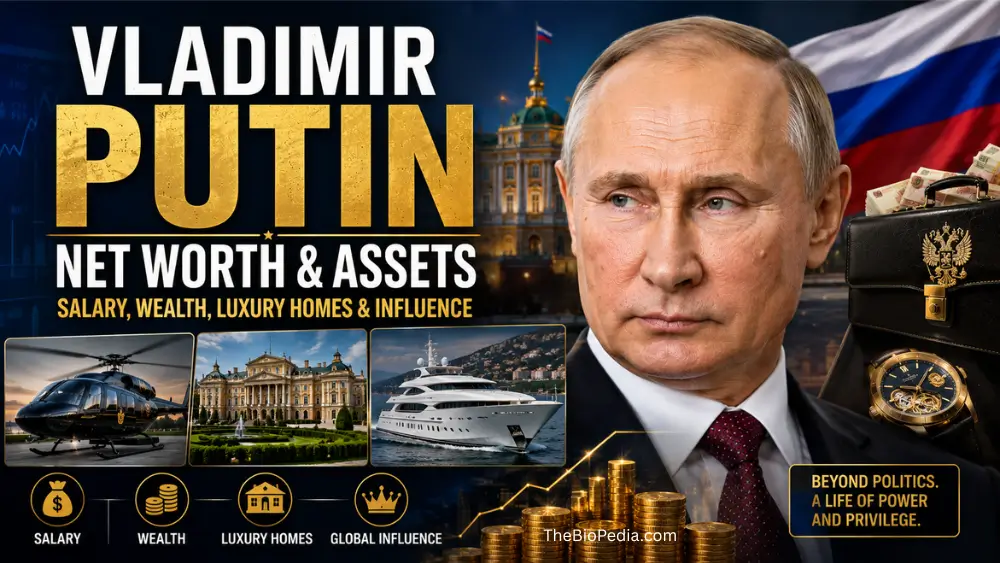
Few questions in modern political life attract as much sustained global interest — and as little definitive answer — as the question of Vladimir Putin’s true net worth. For over two decades, journalists, intelligence analysts, opposition researchers, and foreign governments have attempted to quantify the personal wealth of Russia’s president. The results have ranged from the modest official disclosures of the Russian government to estimates, by some analysts, that would place Putin among the wealthiest individuals in human history.
The gap between these two positions is not merely a matter of degree. It reflects a fundamental structural reality of Putin’s Russia: a system in which political power and economic control are so thoroughly intertwined that traditional concepts of personal ownership become difficult to apply. Putin does not, by most credible accounts, own assets in his own name in the way that a Western billionaire might. Instead, the wealth attributed to him by investigative journalists and intelligence assessors is described as held indirectly — through trusted associates, oligarchs, and institutional structures that place assets nominally beyond his personal ownership while keeping them effectively within his control.
Understanding Vladimir Putin’s wealth — or attempting to — requires understanding this distinction. It also requires maintaining scrupulous clarity about what is verified, what is credibly alleged, and what remains pure speculation. This article provides exactly that: a comprehensive, factually rigorous account of Putin’s official salary and declared assets, the range of media and intelligence estimates of his true wealth, the reported properties and possessions linked to him, the international sanctions targeting his finances, and the ongoing public debate about one of the world’s most consequential — and opaque — financial questions.
For a complete overview of Putin’s life and career, read our comprehensive Vladimir Putin Biography: Age, Early Life, Political Career, Family & Net Worth.
Contents
Quick Facts About Vladimir Putin’s Wealth
The table below provides a concise, sourced reference guide to the key facts about Vladimir Putin’s official and estimated finances:
| Category | Details |
| Official Annual Salary | Approx. 10.7 million Russian rubles (~$120,000–$150,000 USD at recent exchange rates) |
| Officially Declared Assets | Small apartment; modest savings; a few vehicles — per annual presidential disclosure |
| Estimated True Net Worth | $70 billion–$200 billion+ (investigative media estimates; unverified and disputed) |
| Primary Wealth Structure | Alleged indirect control via oligarchs and trusted intermediaries — not direct ownership |
| Key Leaked Documents | Panama Papers (2016); Pandora Papers (2021) — linked associates, not Putin directly |
| Sanctions Status | Personally sanctioned by USA, EU, UK, Canada, Japan, Australia, and others since 2022 |
| Notable Disputed Asset | Black Sea palace near Gelendzhik — alleged value $1 billion+; Kremlin denies ownership |
| Disclosed Foreign Assets | None declared in official Russian presidential asset disclosures |
How Is Vladimir Putin’s Net Worth Estimated?
Estimating the net worth of any head of state is a complex undertaking. Estimating Vladimir Putin’s net worth is among the most complex financial research exercises in the world — complicated by deliberate opacity, an unusual ownership structure, the limitations of Russian financial disclosure law, and the structural intersection of political power and economic control that defines his system of governance.
Why Net Worth Estimates Differ
The dramatic variation in estimates of Putin’s personal wealth — ranging from under a million dollars (his official declaration) to over $200 billion (some analyst estimates) — reflects three distinct factors. The first is the fundamental opacity of Russian financial structures. Unlike publicly listed companies or individuals with verifiable assets in transparent jurisdictions, the wealth attributed to Putin is alleged to be held through layers of shell companies, offshore accounts, and trusted intermediaries operating in jurisdictions with limited disclosure requirements. There is no single public document that establishes the full picture.
The second factor is methodological: different analysts use different approaches to construct their estimates. Some rely primarily on leaked documents — the Panama Papers, the Pandora Papers, and various Russian financial records obtained by investigative journalists. Others rely on intelligence assessments that are not publicly available in full. Still others use reverse-engineering methods — calculating what wealth would be necessary to explain the assets and lifestyles documented through visible evidence. Each method produces different results, and none can be independently verified to a standard that would satisfy rigorous financial scrutiny.
The third factor is the nature of Putin’s alleged wealth itself. The theory most consistently advanced by serious investigators is not that Putin has a conventional investment portfolio or bank accounts in his name. It is that he exercises effective control — without legal ownership — over assets nominally belonging to oligarchs and businesses that serve at his political pleasure. This model of “implicit ownership” or “beneficial control without legal title” makes conventional net worth calculation essentially impossible, because the assets in question are not his by any standard legal definition, even if he can direct their disposition.
Official Financial Disclosures
Russia requires its president and other senior officials to file annual asset declarations — a legal requirement introduced as part of anti-corruption measures and applicable to all senior civil servants and elected officials. Putin’s annual declarations have been publicly available throughout his presidency, and their contents are both specific and, to international observers, remarkably modest.
Putin’s most recent declarations have typically listed the following categories of declared assets: a small apartment in Saint Petersburg (approximately 77 square metres) held with other family members; a garage space; a small plot of land; savings accounts holding several million rubles; and a small collection of vehicles, including domestic Russian-made cars and a trailer. The total declared asset value, converted to US dollars at prevailing exchange rates, has typically been equivalent to approximately $150,000–$250,000 — a sum that, for context, would not place him among even the modestly wealthy by the standards of most developed countries.
The official declarations are, by legal requirement, signed under oath. They do not, however, require disclosure of assets held by other family members, assets nominally owned by third parties, or assets held through corporate structures — all categories that investigators allege are central to the true picture of Putin’s financial position. The declarations satisfy the letter of the legal requirement while, critics argue, disclosing only a fraction of his actual financial reality.
Vladimir Putin’s Official Salary
Presidential Compensation
Vladimir Putin’s official presidential salary is publicly disclosed as part of Russia’s government transparency requirements. His annual salary has been reported at approximately 10.7 million Russian rubles per year — a figure that, at recent exchange rates, equates to roughly $120,000–$150,000 USD annually. This places his official compensation at a level comparable to the salaries of many Western European civil servants, and far below the compensation of most Western heads of government when benefits are included.
For context: the US President’s annual salary is $400,000. The UK Prime Minister’s total compensation package including salary and housing is broadly similar. Germany’s Chancellor earns approximately €360,000 annually. By these comparisons, Putin’s official salary is modest — a fact that is both technically accurate and, given the broader context of his alleged wealth, potentially misleading as a measure of his actual financial position.
Putin’s salary is paid by the Russian federal government and subject to standard Russian income tax — a flat rate of 13% under the tax reforms introduced early in his presidency. Net of tax, his official annual take-home pay is approximately 9.3 million rubles, or roughly $105,000–$130,000 USD. This is the entirety of his officially declared income.
Other Official Benefits
Beyond his official salary, Putin receives a comprehensive package of state benefits that dramatically exceeds what his salary figure suggests in terms of the quality of life and resources available to him in his official capacity. These benefits are standard entitlements of the Russian presidency rather than personal wealth, but they represent enormous practical resource access.
Official residences: as president, Putin has access to the Grand Kremlin Palace as his primary official Moscow seat, the Novo-Ogaryovo presidential estate outside Moscow as his primary working residence, and Bocharov Ruchei on the Black Sea coast near Sochi as his southern presidential retreat. These properties are maintained by the state and staffed by thousands of state employees. They represent among the finest real estate in Russia, available to Putin not as personal property but as presidential entitlements.
Official transportation: the Russian presidential fleet includes multiple aircraft — most prominently an Ilyushin Il-96-300PU (designated as the Russian equivalent of Air Force One) and an Ilyushin Il-96-400M — as well as helicopters, heavily armoured limousines (primarily the domestically produced Aurus Senat, Russia’s answer to the US presidential limousine), and extensive support vehicles. The cost of maintaining and operating this fleet runs to hundreds of millions of dollars annually and is funded by the state.
Security: Putin’s personal security detail — provided by the Federal Protective Service (FSO) — is among the most extensive in the world, estimated to number in the thousands across all its functions. Medical services, communications infrastructure, catering, household staff, and all other operational requirements of the presidency are similarly provided and funded by the Russian state. In practical terms, Putin has personal access to resources that dwarf anything his official salary would suggest.
Estimated Wealth According to Public Reports
The following section summarises the range of estimates of Putin’s true personal wealth as reported by credible investigative media, analysts, and public sources. All figures in this section are estimates — they are not confirmed facts, they are contested by the Kremlin, and they cannot be independently verified to a rigorous financial standard. They are presented here because they represent the best available public understanding of a question of significant public interest.
Media and Analyst Estimates
The most frequently cited high-end estimate of Putin’s personal wealth comes from Bill Browder — the American-born British financier and prominent Kremlin critic, whose former partner Sergei Magnitsky was killed in Russian custody and whose advocacy led to the Magnitsky Acts in multiple Western countries. Browder has publicly estimated Putin’s personal wealth at approximately $200 billion, based on his assessment of the oligarchic wealth that Putin effectively controls through his political position. This figure is the highest widely cited estimate and is also among the most contested.
Other analysts and investigative teams have produced estimates in a broad range — typically $70 billion to $200 billion — with the variation reflecting different methodological approaches and different assessments of what assets should be attributed to Putin’s effective control. US Senate intelligence committee reports have referenced intelligence community assessments suggesting Putin’s wealth falls within this general range, though the specific underlying analysis has not been publicly released.
The Panama Papers — the 2016 leak of 11.5 million documents from the Panamanian law firm Mossack Fonseca — included information linking associates of Putin, including members of his inner circle and his personal cellist friend Sergei Roldugin, to offshore financial structures holding hundreds of millions of dollars in assets. Roldugin himself, when asked about the funds, described them as donations collected for cultural projects. The documents did not establish direct legal ownership by Putin of the offshore assets, but they revealed the mechanism by which wealth could be held by trusted associates beyond the reach of official disclosure requirements.
The Pandora Papers — a 2021 leak of approximately 12 million documents from offshore financial services firms — similarly linked Putin associates to complex offshore structures, providing additional evidence of the financial architecture surrounding Russia’s political elite without establishing Putin’s direct ownership of specific assets.
Why Estimates Remain Unverified
Despite the volume of investigative reporting, the estimates of Putin’s personal wealth remain fundamentally unverifiable for a combination of structural reasons. The first is the indirect ownership model: if the assets attributed to Putin are genuinely held in the names of third parties — oligarchs, nominees, corporate structures — then no document establishing Putin’s personal legal ownership exists to be found. The relationship between Putin and these assets is one of political power and mutual interest rather than documented legal title.
The second reason is jurisdictional: the offshore structures in which Putin-linked wealth is alleged to be held are typically domiciled in jurisdictions — from the British Virgin Islands to Cyprus to the Cayman Islands — where beneficial ownership disclosure requirements are minimal or opaque. Western investigators can identify the structures; they cannot necessarily see through them to the beneficial owner.
The third reason is the political environment in Russia, where the investigative journalism that would be required to document Putin’s financial position from the Russian side is effectively impossible. Journalists who have attempted serious investigations into Kremlin finances — most notably Novaya Gazeta reporters — have faced serious consequences. The assassination of journalist Anna Politkovskaya, and the deaths of multiple other Russian journalists covering sensitive Kremlin topics, has had a documented chilling effect on domestic financial investigation.
Key Sources and Their Estimates: A Comparison
| Source | Estimate | Basis / Notes |
| Bill Browder (investor & Kremlin critic) | $200 billion+ | Based on alleged control of oligarch-held assets; often cited but widely contested |
| Various US Senate Intelligence assessments | $70–$200 billion | Range based on intelligence community analysis; not publicly detailed |
| Panama Papers / Pandora Papers | Undisclosed billions | Linked Putin associates to offshore structures; no direct ownership established for Putin |
| Navalny Foundation investigation | $1 billion+ (palace alone) | Documentary evidence of alleged personal palace; Kremlin denies ownership |
| Forbes / Bloomberg | Not listed (officially) | Putin excluded from billionaire rankings due to lack of verifiable direct asset ownership |
| Putin’s own declaration | ~$230,000 USD equivalent | Official Russian government disclosure; modest apartment, savings, vehicles |
Luxury Homes and Official Residences
Presidential Residences
Vladimir Putin has access to a number of official presidential residences that are state property rather than personal assets — available to him as head of state and maintained at public expense. The most significant of these are:
The Grand Kremlin Palace in Moscow — the historic centre of Russian political power, a complex of buildings within the Moscow Kremlin used for state ceremonies, official receptions, and presidential functions. The palace’s grand halls and ceremonial rooms are among the most recognizable architectural symbols of Russian state power.
Novo-Ogaryovo — an estate on the Rublyovskoye Highway west of Moscow that has served as Putin’s primary working residence and base of operations throughout his presidency. The estate includes multiple buildings, extensive grounds, and the full infrastructure of a working presidential compound. This is where Putin is understood to spend the majority of his working time when in the Moscow region.
Bocharov Ruchei — the presidential residence near Sochi on the Black Sea coast, used for summer residency and for bilateral diplomatic meetings with foreign leaders who visit Russia. The residence has been extensively renovated during Putin’s presidency and is one of the primary settings for his international diplomatic engagements.
Valdai — a lakeside presidential retreat in the Novgorod region of northwestern Russia, used for rest and recreation and as the setting for the annual Valdai Discussion Club meetings, which bring together international analysts and officials for substantive policy discussions with Putin.
Reported Luxury Properties
Beyond the official state residences, a number of properties have been linked to Putin through investigative journalism — with varying degrees of evidentiary support and varying responses from the Kremlin. It is essential to distinguish clearly between confirmed state residences and disputed alleged personal properties.
The Black Sea Palace (Gelendzhik) — the most extensively documented alleged personal property linked to Putin is a vast estate on the Black Sea coast near Gelendzhik in the Krasnodar region. The property was the subject of a detailed investigative documentary released by the Navalny Foundation in January 2021, which alleged it was a personal residence for Putin built with funds from corrupt Russian businessmen. The documentary described the property as featuring a casino, theatre, private beach, elaborate landscaping, and luxury interiors reportedly valued in total at over one billion dollars. The Kremlin denied that the property belongs to Putin. The businessman Arkady Rotenberg subsequently came forward to claim ownership of the estate. The question of ultimate beneficial ownership remains unresolved and disputed.
Praskoveevka Compound — investigative reporting has also identified a separate compound near the Black Sea village of Praskoveevka, with restricted access and infrastructure suggesting use by a senior official. The Kremlin has neither confirmed nor denied any specific claims about this property.
Properties Near Moscow — various investigative reports have identified several large estate properties in the Moscow region — particularly along the Rublyovskoye Highway corridor historically favoured by the Russian elite — that have been linked to Putin through property records and investigative inference. The legal ownership of these properties has not been established as Putin’s in publicly verifiable documents.
Vehicles, Aircraft & Other Reported Assets
Official Transportation
As president of the Russian Federation, Putin has access to a comprehensive official transportation fleet provided and maintained by the state. This fleet is not personal property but is available to him as a function of his office — similar to the transportation arrangements of any major head of state.
The presidential aviation fleet includes multiple long-range aircraft. The primary presidential aircraft is an Ilyushin Il-96-300PU — a wide-body, four-engine jet configured for presidential use with communications and security equipment. A second variant, the Ilyushin Il-96-400M, has been introduced as a newer addition to the fleet. These aircraft are the Russian equivalents of Air Force One and are operated by the Russian government’s special aviation division. Their interior configurations — reportedly featuring luxury fittings, secure communications, medical facilities, and conference rooms — have been described in media reports but not officially detailed.
The presidential motorcade is centered on the Aurus Senat — a domestically produced Russian luxury limousine developed specifically for the presidential fleet and unveiled in 2018. The Aurus project was a flagship of Putin’s push for Russian industrial self-sufficiency in strategic sectors. The presidential motorcade typically includes multiple Aurus vehicles, extensive security outriders, and a range of support and countermeasures vehicles. Putin’s personal security detail’s vehicles are armoured to high specifications.
Luxury Watches and Personal Possessions
One of the more unusual recurring subjects of media scrutiny in relation to Putin’s personal wealth is his watch collection. Over the course of his presidency, Putin has been photographed wearing a range of luxury timepieces — including models from Patek Philippe, A. Lange & Söhne, Blancpain, and other high-end Swiss manufacturers — with individual watches estimated by horological journalists at values ranging from tens of thousands to several hundred thousand dollars.
The watch observations have been systematically documented by Novaya Gazeta and other outlets, which noted that the aggregate retail value of watches photographed on Putin’s wrist over the years significantly exceeds his official declared income for the corresponding periods — raising questions about the source of funds for these purchases. Putin has not publicly addressed these specific observations. The Kremlin’s general position is that gifts received in an official capacity are handled through official gift protocols.
A superyacht named Graceful — a 86-metre vessel reportedly valued at approximately $100 million — was widely reported in Western media as being linked to Putin. The vessel was moved from a German port to the Russian-controlled port of Kaliningrad shortly before the February 2022 invasion of Ukraine, apparently in anticipation of Western sanctions. The Kremlin has denied Putin’s ownership of the vessel. The yacht was subsequently subject to Russian state sanctions countermeasures following the Western sanctions on Russia.
Financial Influence and Political Power
Influence Beyond Personal Wealth
Perhaps the most important aspect of Vladimir Putin’s financial position is not his personal wealth — however significant or modest that may be — but his influence over the Russian economy and the extraordinary resources that flow from his position as head of state of a major energy-exporting nation. As president, Putin has effective authority over an economy with a GDP of approximately $2 trillion annually, control over the world’s largest proven natural gas reserves, and decision-making authority over the Russian state’s $600 billion-plus federal budget.
This economic authority translates into a form of practical financial power that dwarfs any personal wealth figure. Putin can direct state investment, control the terms on which foreign companies operate in Russia, determine which oligarchs have access to state contracts and favourable regulatory treatment, and set the framework within which Russia’s strategic industries — energy, defence, metals, finance — operate. This is not personal wealth in any conventional sense, but it is power over resources on a scale that no personal fortune could replicate.
The relationship between Putin’s political authority and the wealth of Russia’s oligarchs is one of the defining structural features of the Putin system. The oligarchs — individuals who accumulated enormous wealth during the privatizations of the 1990s or who have built fortunes in the Putin era — operate under an implicit understanding: their wealth is protected by and contingent upon their political loyalty and their willingness to serve state interests when required. This system, sometimes described as crony capitalism or state capture, gives Putin effective access to the resources of individuals whose combined wealth runs to hundreds of billions of dollars, without those resources appearing in any of his personal financial declarations.
Russia’s Economy During Putin’s Leadership
Russia’s economy under Putin has passed through several distinct phases that are essential context for understanding the financial environment in which his presidency has operated. The first phase — roughly 2000 to 2008 — was one of dramatic growth driven by rising global oil and gas prices. Russia’s GDP expanded at an average of approximately 7% per year, poverty rates fell sharply, and the government accumulated significant sovereign wealth reserves. This period generated the foundation of the oligarchic wealth that is central to the financial landscape surrounding Putin.
The energy sector has been the cornerstone of Russia’s economic model throughout Putin’s presidency. Russia’s state energy companies — Gazprom (natural gas) and Rosneft (oil), both effectively under state control — are among the largest energy companies in the world and generate revenues that are central to the Russian federal budget. Putin’s close management of these companies, including the renationalization of Yukos oil company after the arrest of its owner Mikhail Khodorkovsky in 2003, established the Kremlin’s direct authority over Russia’s most strategically significant economic assets.
The economic consequences of the 2022 Ukraine invasion — including the disconnection of Russian energy from European markets, the freezing of approximately $300 billion in Russian central bank reserves, and sweeping restrictions on Russian financial institutions’ access to the international banking system — have significantly damaged the Russian economy while also accelerating Russia’s reorientation toward trade with China, India, and other non-sanctioning economies. The long-term economic cost of the Ukraine conflict and associated sanctions remains an active and contested question among economists.
International Sanctions and Financial Scrutiny
Sanctions Imposed by Western Countries
The sanctions regime targeting Vladimir Putin personally — and the broader Russian economy — represents the most extensive coordinated financial pressure campaign in modern history. Personal sanctions against Putin were imposed by the United States, European Union, United Kingdom, and other Western governments in the immediate aftermath of Russia’s full-scale invasion of Ukraine in February 2022, with some earlier targeted measures dating to the 2014 annexation of Crimea.
Personal sanctions against Putin typically include an asset freeze — a legal prohibition on any individual or institution within the sanctioning jurisdiction transacting with Putin or holding assets on his behalf — and a travel ban preventing him from entering the sanctioning jurisdiction. These measures apply not only to Putin directly but to a wide network of oligarchs, officials, family members, and associates believed to manage assets on his behalf or to benefit from their proximity to his power.
The practical impact of personal sanctions on Putin is constrained by the structure of his alleged wealth — which, as described above, is believed to be held largely outside the direct legal ownership of Putin himself and outside Western jurisdictions. However, the sanctions on oligarchs believed to hold assets on his behalf have resulted in the seizure and freezing of billions of dollars of Russian-linked assets in European and American jurisdictions, including superyachts, real estate, bank accounts, and corporate holdings.
Major Sanctions Against Vladimir Putin: A Reference Overview
| Country / Bloc | Date | Scope |
| United States | March 2022 | Executive Order 14024 — asset freeze, travel ban; extended to family members and associates |
| European Union | February 2022 | Regulation 2022/336 — asset freeze and travel ban; progressively expanded across 13+ sanctions packages |
| United Kingdom | February 2022 | Russia (Sanctions) (EU Exit) Regulations — asset freeze, travel ban, financial restrictions |
| Canada | February 2022 | Special Economic Measures Act — asset freeze targeting Putin and inner circle |
| Australia | March 2022 | Autonomous Sanctions Act — asset freeze and travel ban |
| Japan | March 2022 | Foreign Exchange and Foreign Trade Act — asset freeze and export controls |
| Switzerland | March 2022 | Adopted EU sanctions framework — asset freezes including on Putin personally |
Beyond direct personal sanctions, the broader Russia sanctions regime — including restrictions on the Russian central bank, the exclusion of major Russian banks from the SWIFT international payments system, and the imposition of export controls on technology products — has had far more significant macroeconomic consequences for Russia than the personal sanctions on Putin alone.
Global Financial Oversight
The question of Putin’s personal finances has attracted sustained attention from international financial oversight bodies, investigative journalism networks, and academic researchers, in part because it illustrates broader questions about the intersection of political power and hidden wealth in authoritarian systems. The Organized Crime and Corruption Reporting Project (OCCRP), the International Consortium of Investigative Journalists (ICIJ), Transparency International, and various academic centres studying kleptocracy have all produced significant research on Putin-linked financial structures.
The 2022 decision by Western governments to freeze approximately $300 billion in Russian central bank reserves — sovereign assets of the Russian state held in foreign central banks and financial institutions — was unprecedented in scope and triggered significant legal and financial debates about the circumstances under which sovereign assets can be seized. This measure, while not specifically targeting Putin’s personal wealth, represented the most financially significant consequence of the Ukraine invasion for Russia’s state finances and generated ongoing discussions about the potential transfer of these funds to Ukraine for reconstruction purposes.
The International Criminal Court’s issuance of an arrest warrant for Putin in March 2023 — related to the alleged unlawful deportation of Ukrainian children — has added a legal dimension to the international scrutiny of his position. While the practical enforceability of the ICC warrant is limited given Russia’s non-membership of the Rome Statute, its existence means that Putin faces formal legal jeopardy in the 124 countries that are ICC member states — a constraint on his international travel that has become increasingly significant.
Public Perception of Putin’s Wealth
Supporters’ Views
Among Putin’s supporters within Russia — a group that, according to domestic polling conducted under conditions of limited press freedom, remains substantial — the question of his personal wealth is typically framed within the Kremlin’s official narrative. The official position is straightforward: Putin is a dedicated public servant whose personal financial position is as declared in his annual asset filings — modest by the standards of his office, consistent with a man who has devoted his life to state service rather than personal enrichment.
Supporters also frequently point to what they describe as the politically motivated character of the wealth allegations — arguing that the estimates advanced by Western governments, opposition figures like the late Alexei Navalny, and international investigative networks are instruments of information warfare designed to delegitimize Putin’s leadership rather than genuine financial inquiries. From this perspective, the persistence of wealth allegations despite the absence of conclusive legal proof is itself evidence of their political rather than evidentiary foundation.
There is also a strand of Russian public opinion that, even if it accepts that Putin may have accumulated significant personal wealth, regards this as either a natural consequence of his political position or as less important than the stability and national prestige associated with his leadership. In a country where corruption has historically been endemic at all levels of public life, the question of a leader’s personal enrichment carries different moral weight than it might in societies with stronger traditions of governmental transparency.
Critics’ Views
Critics — including Western governments, international human rights organizations, Russian opposition movements, and investigative journalism networks — frame Putin’s financial position as one of the most significant examples of large-scale kleptocracy in modern political history. The core allegation is that Putin has, over 25 years in power, constructed a system in which Russia’s state resources, regulatory authority, and political power have been systematically channelled to enrich himself and his inner circle — at the expense of the Russian public and of the international financial norms that govern legitimate statecraft.
The Navalny Foundation’s investigations — including the 2021 Black Sea palace documentary, which attracted over 100 million views on YouTube before being restricted in Russia — represented the most high-profile domestic presentation of this critique, directly connecting specific named assets to Putin’s personal use and documenting the financial flows alleged to have funded them. Navalny’s death in custody in February 2024, widely attributed internationally to the Russian state, has if anything intensified international attention to the corruption critique he embodied.
International transparency advocates argue that the opacity of Putin’s finances is not merely a personal ethical matter but a structural threat to global financial integrity — because the systems that enable Putin to hold and move wealth invisibly are the same systems used by other authoritarian leaders, criminal networks, and corrupt officials worldwide. Addressing Putin’s wealth, in this analysis, requires systemic reform of international financial transparency standards, not merely individual sanctions.
Interesting Facts About Vladimir Putin’s Wealth
Here are some revealing facts about Putin’s official and alleged finances that are frequently referenced in global coverage:
- Official Salary Is Publicly Disclosed — and Modest: Putin’s official annual presidential salary of approximately 10.7 million rubles (~$120,000–$150,000 USD) is publicly available in Russian government records — and is lower than the salaries of many Western European civil servants and far below Western heads of state compensation packages.
- His Declared Personal Assets Would Not Make Him Wealthy by Any Standard: Based on his official declarations, Putin’s personally owned assets — a small apartment, savings, a few vehicles — total the equivalent of perhaps $150,000–$250,000 USD. By comparison, the average American household net worth is approximately $192,000, making Putin’s declared position essentially ordinary by US standards.
- Net Worth Estimates Vary by a Factor of Nearly 3,000: The gap between Putin’s official declared wealth (~$200,000 equivalent) and the highest media estimates ($200 billion+) represents a difference of approximately 1,000,000% — illustrating the extraordinary uncertainty surrounding the true picture.
- The Panama Papers Linked His Inner Circle to Offshore Billions: The 2016 Panama Papers leak revealed offshore financial structures linked to Putin associates — including his personal friend Sergei Roldugin — involving hundreds of millions of dollars. Putin himself was not directly named as an owner in the leaked documents.
- His Luxury Watches Have Been Documented as Exceeding His Declared Income: Russian investigative journalists have photographed Putin wearing timepieces from Patek Philippe, A. Lange & Söhne, and other luxury brands — with the aggregate retail value of documented watches significantly exceeding his official declared income for the years in question.
- A Superyacht Was Moved from Germany to Russia Days Before the 2022 Invasion: The vessel Graceful — reportedly linked to Putin — was relocated from a German shipyard to Kaliningrad shortly before Russia’s February 2022 invasion of Ukraine, apparently in anticipation of Western asset seizures. The Kremlin denied Putin’s ownership.
- Western Sanctions Have Frozen Billions Linked to Putin’s Associates: While personal sanctions on Putin are limited in effect by his ownership structure, sanctions on oligarchs linked to him have resulted in the seizure and freezing of billions in yachts, aircraft, real estate, and financial assets in European and American jurisdictions.
- He Has Never Publicly Explained the Source of Lifestyle Discrepancies: Despite persistent media questions about the gap between his modest official salary and the luxury assets attributed to him, Putin has never provided a detailed public explanation of how his lifestyle is funded — beyond general dismissals of the allegations as politically motivated.
FAQs
What is Vladimir Putin’s net worth?
Vladimir Putin’s official declared net worth — based on Russian government annual asset disclosures — is equivalent to approximately $150,000–$250,000 USD: a small apartment, modest savings, and a few vehicles. However, investigative journalists, Western intelligence assessments, and analysts including Bill Browder have estimated his true wealth at between $70 billion and $200 billion or more, held indirectly through trusted associates and offshore structures. These estimates are unverified and disputed by the Kremlin. The true figure is unknown and may be unknowable given the structural opacity of his alleged wealth arrangements.
What is Vladimir Putin’s official salary?
Vladimir Putin’s official presidential salary is approximately 10.7 million Russian rubles per year — equivalent to roughly $120,000–$150,000 USD at recent exchange rates, depending on the ruble’s value. This is his only officially declared income. Net of Russia’s 13% flat income tax, his official take-home pay is approximately 9.3 million rubles annually. He additionally receives the full package of state benefits available to the Russian president, including official residences, transportation, security, and staff — all funded by the state rather than from his salary.
Is Vladimir Putin considered one of the world’s richest leaders?
In terms of officially declared personal wealth, Putin is notably modest by the standards of major world leaders. In terms of estimated true wealth, analysts who have attempted to calculate his indirect financial position — including through his alleged control of oligarch-held assets — have suggested figures that would place him among the wealthiest individuals on earth. However, these estimates are unverified. Forbes and Bloomberg do not include Putin in their billionaire rankings, citing the inability to establish verifiable direct personal ownership of assets. The question of whether Putin should be considered among the world’s richest people depends fundamentally on how one defines personal wealth in the context of his unusual system of indirect control.
What assets are officially declared by Vladimir Putin?
Putin’s official annual asset declarations — publicly filed as required by Russian law — have typically listed the following: a small apartment in Saint Petersburg (approximately 77 square metres); a garage space; a small plot of land; savings accounts holding several million rubles; and a small number of vehicles, including domestically produced Russian cars. The total value of these declared assets is equivalent to approximately $150,000–$250,000 USD at prevailing exchange rates — a declaration that critics describe as legally compliant but profoundly incomplete given the investigative evidence of assets held through intermediaries.
Does Vladimir Putin own luxury homes?
Vladimir Putin officially owns only the modest apartment declared in his annual asset filings. However, investigative reporting — most prominently the Navalny Foundation’s 2021 documentary — has alleged that a vast palace on the Black Sea coast near Gelendzhik, reportedly valued at over one billion dollars, is a personal residence for Putin built with funds from oligarchic donors. The Kremlin has denied that the property belongs to Putin, and businessmen with Kremlin connections have claimed ownership. Beyond this, various investigative outlets have reported on other large properties linked to Putin through ownership records and investigative inference. None of these properties has been legally established as Putin’s personal property in publicly verifiable court or registry records.
Why are estimates of Putin’s wealth so different?
The dramatic variation in wealth estimates reflects three core factors: (1) the indirect ownership structure through which Putin’s wealth is alleged to be held — not in his name, but through oligarchs, nominees, and offshore structures — makes legal verification impossible; (2) different methodological approaches by different analysts produce different results, from leaked document analysis to intelligence assessment to visible asset inference; and (3) the political environment in Russia makes the domestic investigative journalism that might resolve these questions both dangerous and effectively impossible. The result is a range of estimates spanning several orders of magnitude, with no single authoritative figure that commands broad credibility.
Have sanctions affected Vladimir Putin’s finances?
Personal sanctions on Putin — asset freezes and travel bans imposed by the US, EU, UK, and other Western governments — have limited direct financial impact given that his alleged wealth is held indirectly through associates rather than in his own name. However, the broader sanctions regime on Russia and on oligarchs linked to Putin has had significant practical consequences: billions of dollars in yachts, aircraft, real estate, and financial assets linked to the Russian elite have been frozen or seized in Western jurisdictions. The freezing of approximately $300 billion in Russian central bank reserves was the single largest financial consequence of the 2022 invasion, affecting Russia’s macroeconomic position rather than Putin’s personal finances directly.
Conclusion
Vladimir Putin’s net worth and financial position represent one of the most consequential and most thoroughly examined — yet ultimately unresolved — financial questions in the modern world. The gap between his official declared assets of a few hundred thousand dollars and the estimates of $70 billion to $200 billion attributed to him by serious investigators is not merely a number; it is a window into the fundamental architecture of power in Putin’s Russia, where the boundaries between the personal, the political, and the institutional are deliberately and systematically obscured.
What can be stated with certainty is this: Putin’s official salary and declared assets place him, on paper, among the modestly comfortable rather than the ultra-wealthy. Everything beyond that official picture is a matter of investigative inference, intelligence assessment, and careful analysis of the financial structures surrounding Russia’s political elite — all pointing in the same general direction, but none providing the kind of verifiable legal evidence that would satisfy the standards of rigorous financial proof.
Understanding Putin’s finances requires understanding the system he has built — one in which political power and economic control are so thoroughly merged that personal wealth, in the conventional sense, becomes almost a secondary category. The real measure of Putin’s financial position may not be what he owns, but what he controls — and by that measure, the most accurate description of his financial power may be the Russian economy itself.
Continue Reading Articles on Vladimir Putin:
- For the complete biography, read Vladimir Putin Biography: Age, Early Life, Political Career, Family & Net Worth
- For the political story, read Vladimir Putin Political Career Timeline: From Prime Minister to Russian President
- For his personal life, read Vladimir Putin Family, Wife & Personal Life
- For his origins in Soviet intelligence, read Vladimir Putin Early Life & KGB Career: How He Entered Russian Politics